TODAY IS THE LAST DAY OF THE REST OF YOUR LIFE by Ulli Lust

ulli1

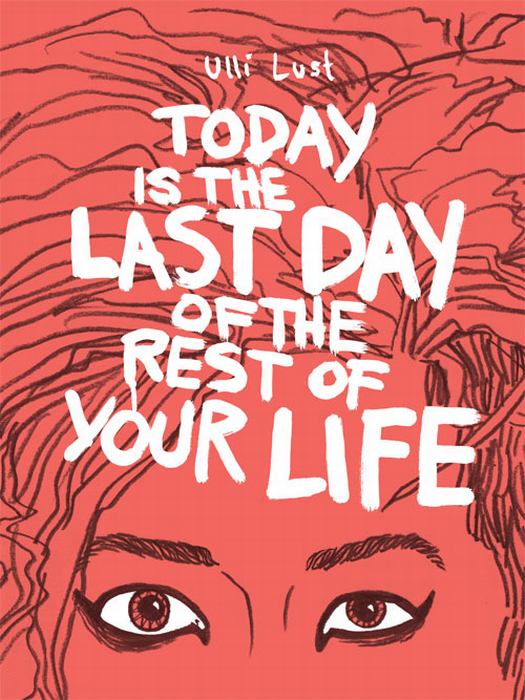
Weighing in at a brick-like, almost cubic 463 pages, Ulli Lust’s newly translated book TODAY IS THE LAST DAY OF THE REST OF YOUR LIFE is frighteningly heavy and lighter than air. Detailing the story of two seventeen-year-old Austrian punk girls on the run from nothing in particular, it has a you-are-there intensity and a lucid, judgeless gaze.

This memoir comic follows the author Ulli and her friend Edi as they travel aimlessly across Western Europe, thumbs out, hearts and legs open. They just wander down the road with no money in their pockets and not so much as a backpack or a change of clothes. They believe that their high spirits and good looks will buoy them as they float like corks on the waves, tossed from the city to the shore, through the Italian unknown.
DSCN1474 (2)

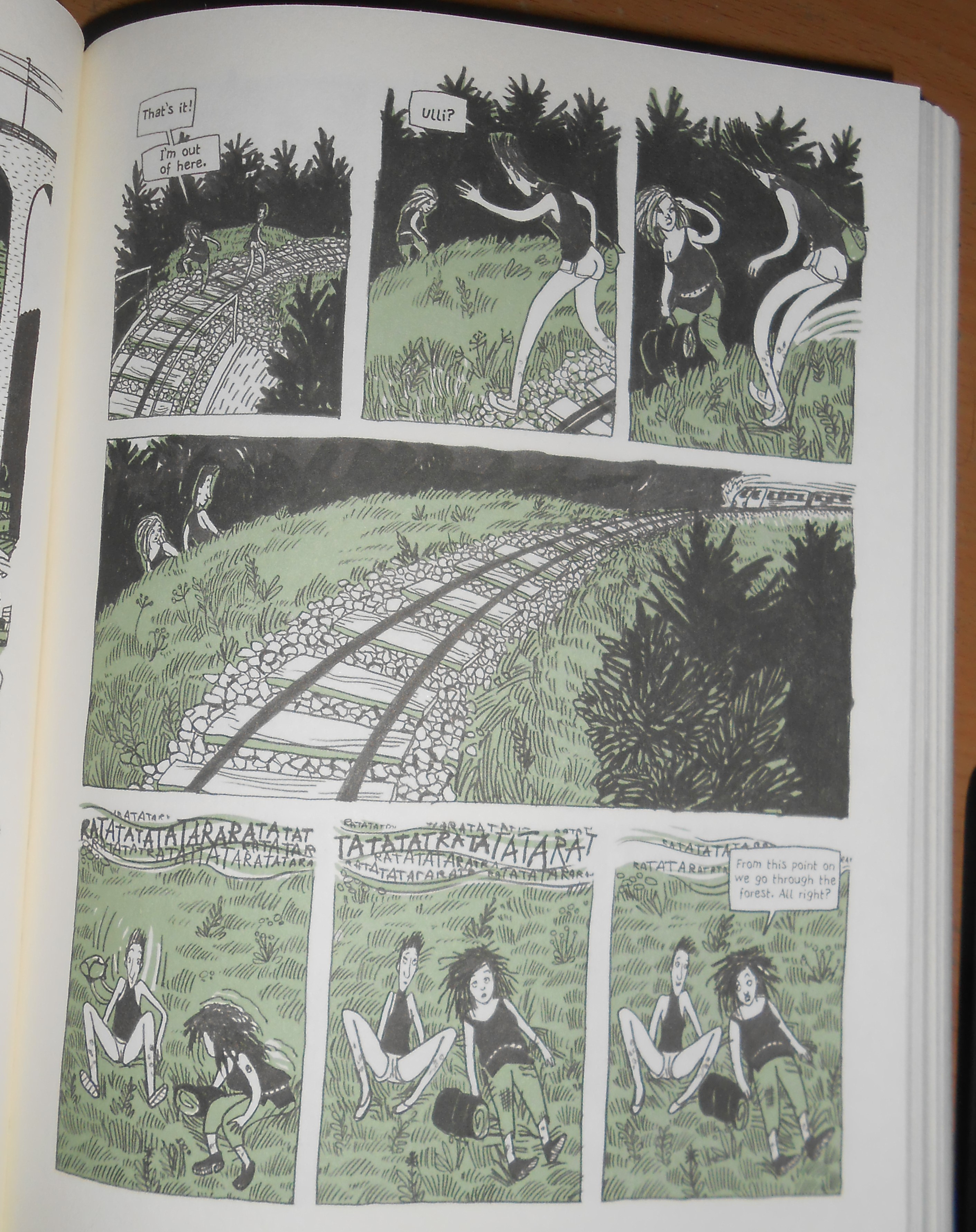
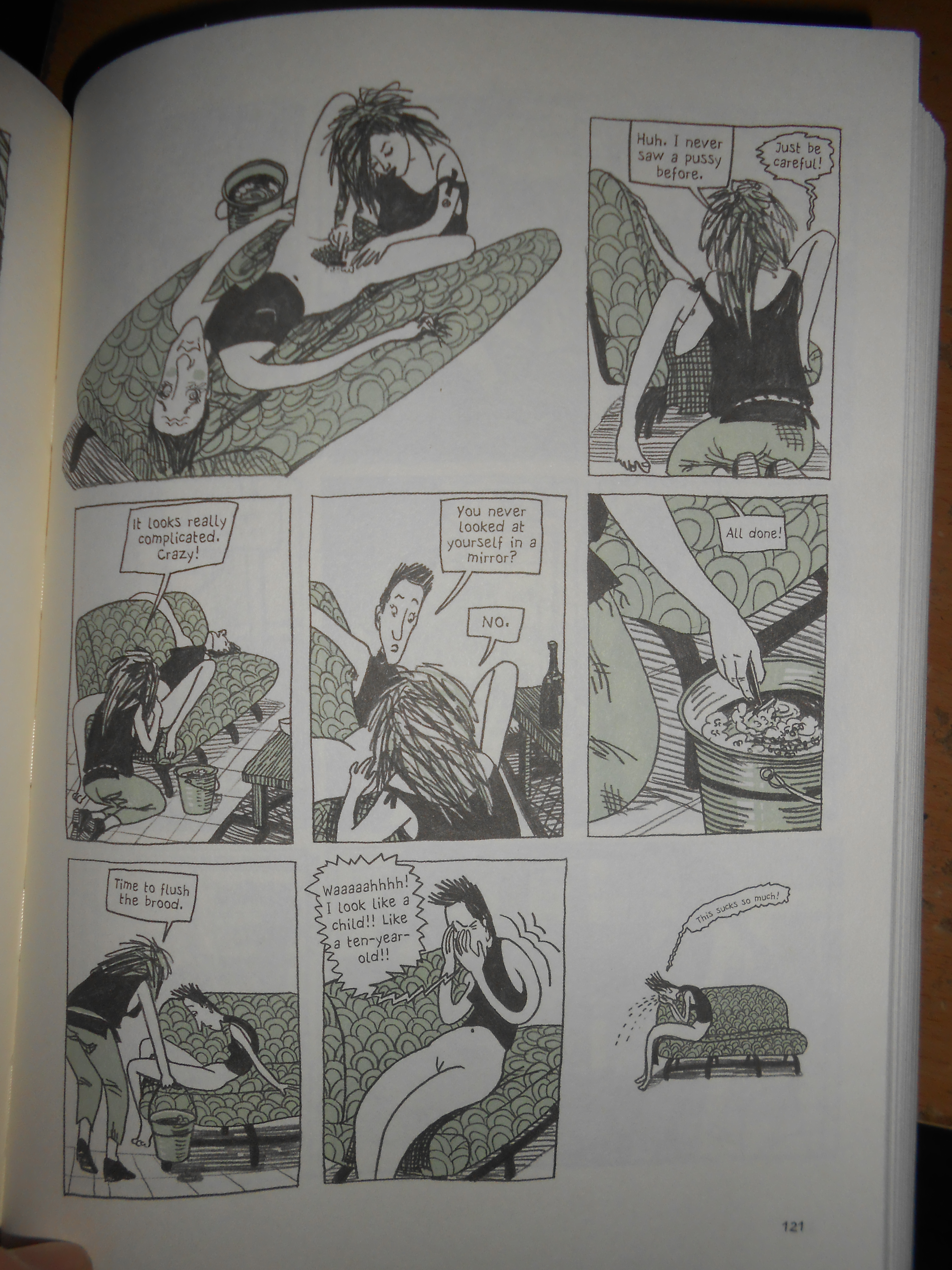
The first thing that strikes you about Lust’s story is its matter-of-factness, its utter lack of manipulation. An early scene in which Ulli and Edi shave each other’s pubes to quell an outbreak of crabs is icky and funny and worrisome, but it isn’t played for gross-out comedy or finger-wagging moralism. You get the sense she’s just depicting the scene as best she remembers it. Jaime Hernandez’s back-cover blurb remarks on “the small details that create great character,” and Lust seems more interested in the odd, specific fragments of her recollection than she is in the heavy emotional moments of her story. She is at her best as a storyteller when Ulli tries to tear a piece off her t-shirt and tie it into a bikini bottom so she can go swimming, or learns how to beg for food in Italian restaurants, or when she’s sleeplessly itching her mosquito bites. These are the real moments of life on the road — not the adventures or destinations or sights but the tiny inconveniences, the tips taken and applied, the weird little experiences that separate the actuality from the travelogue.
DSCN1472

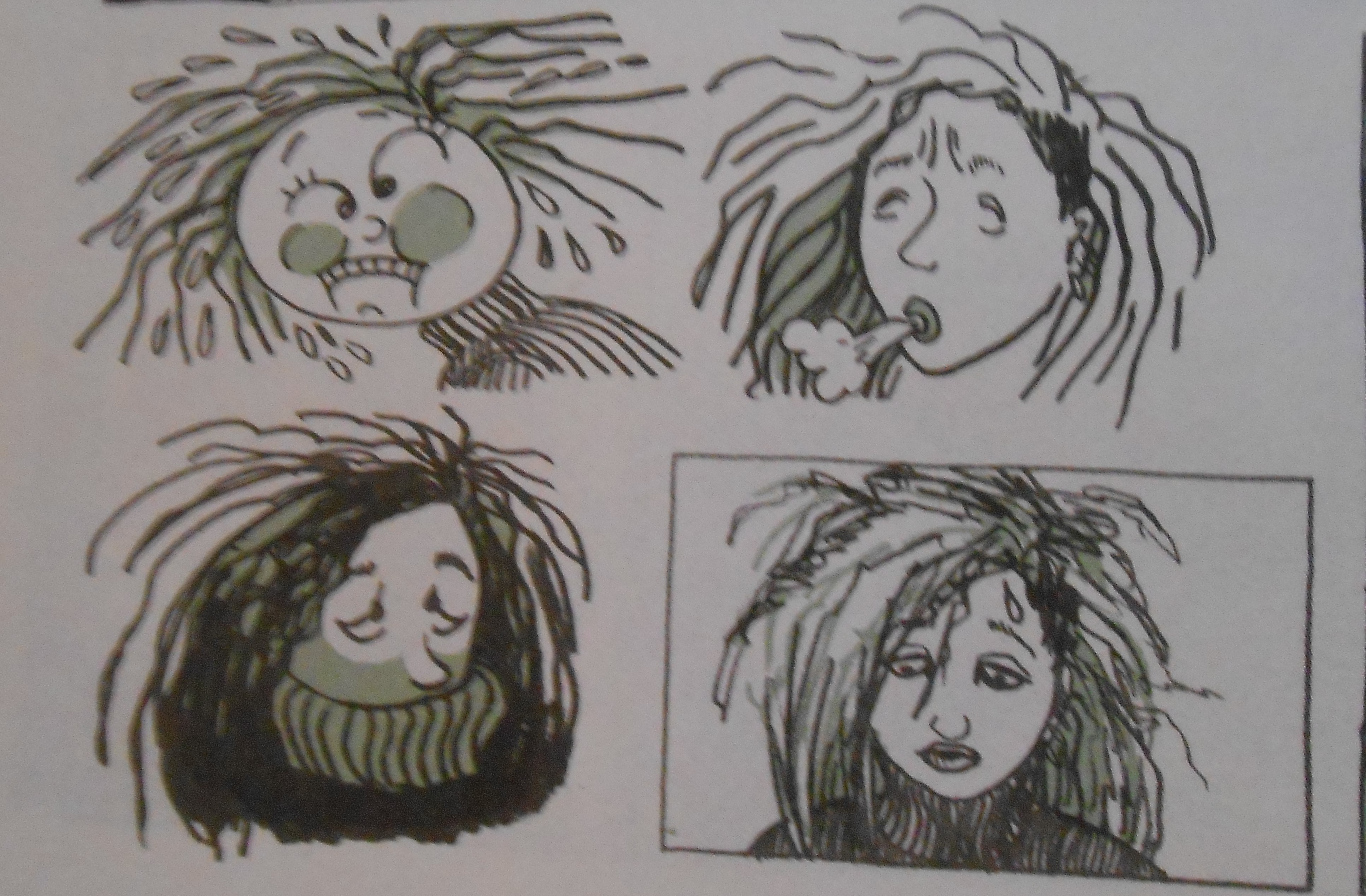
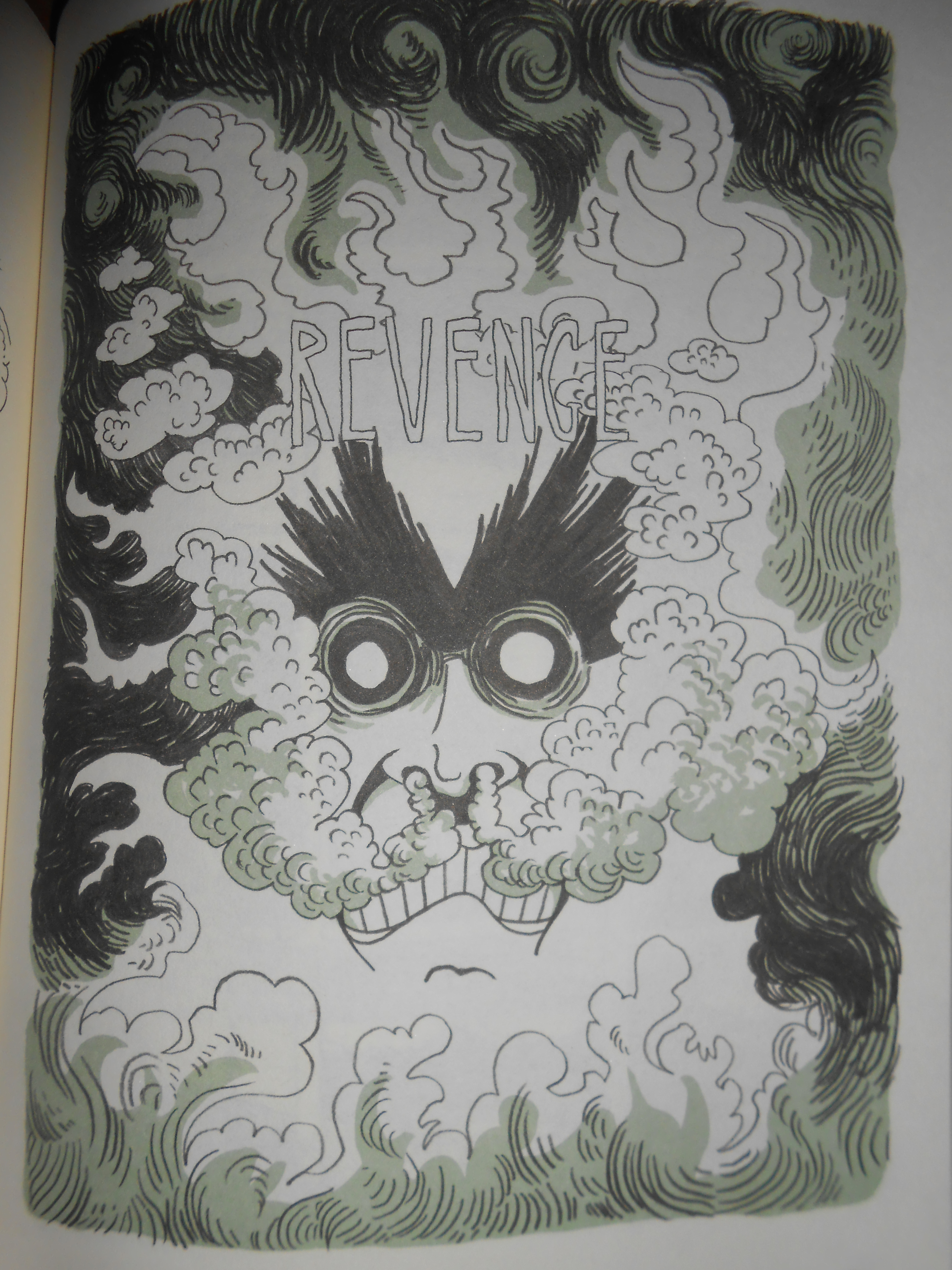
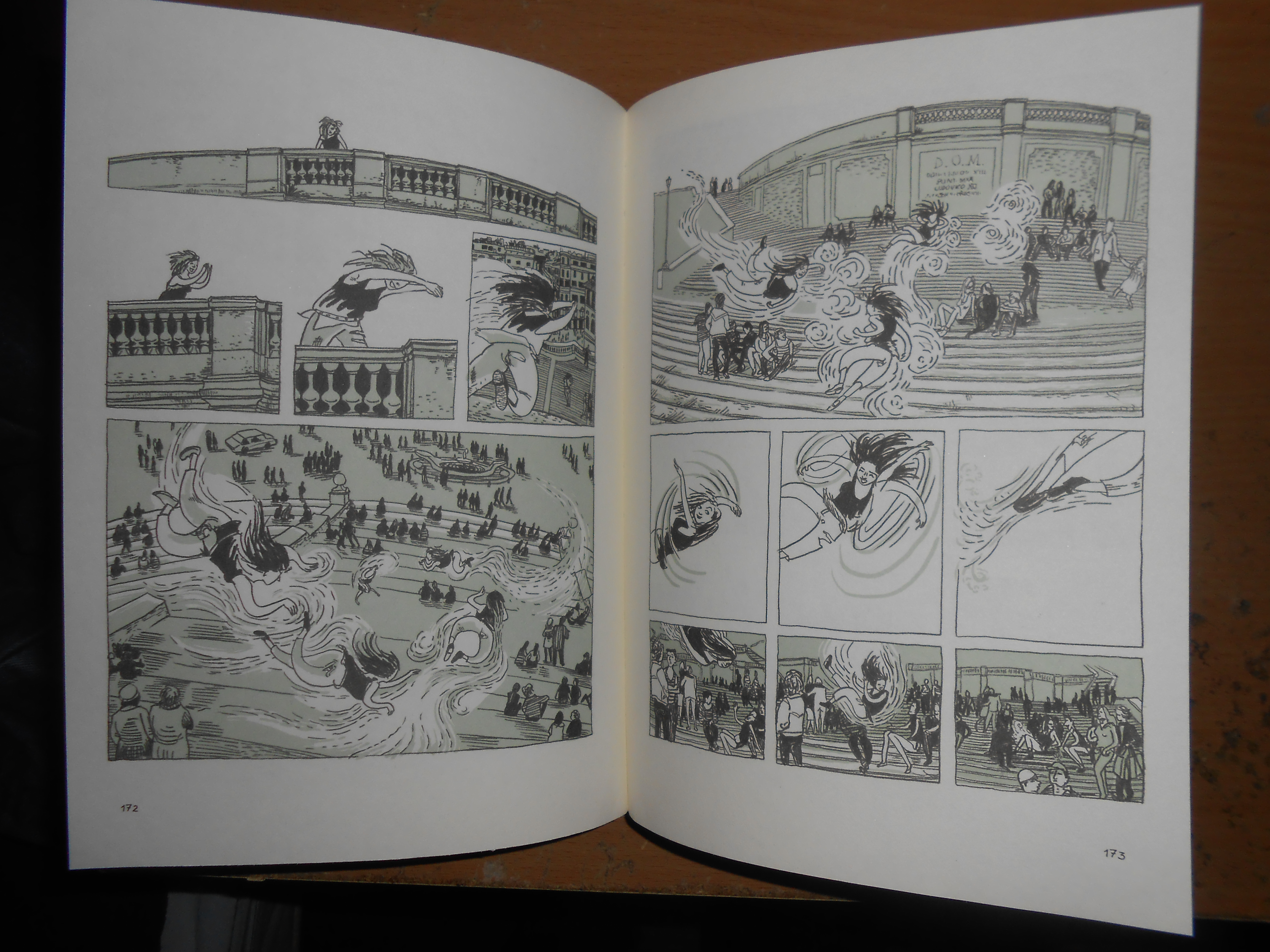
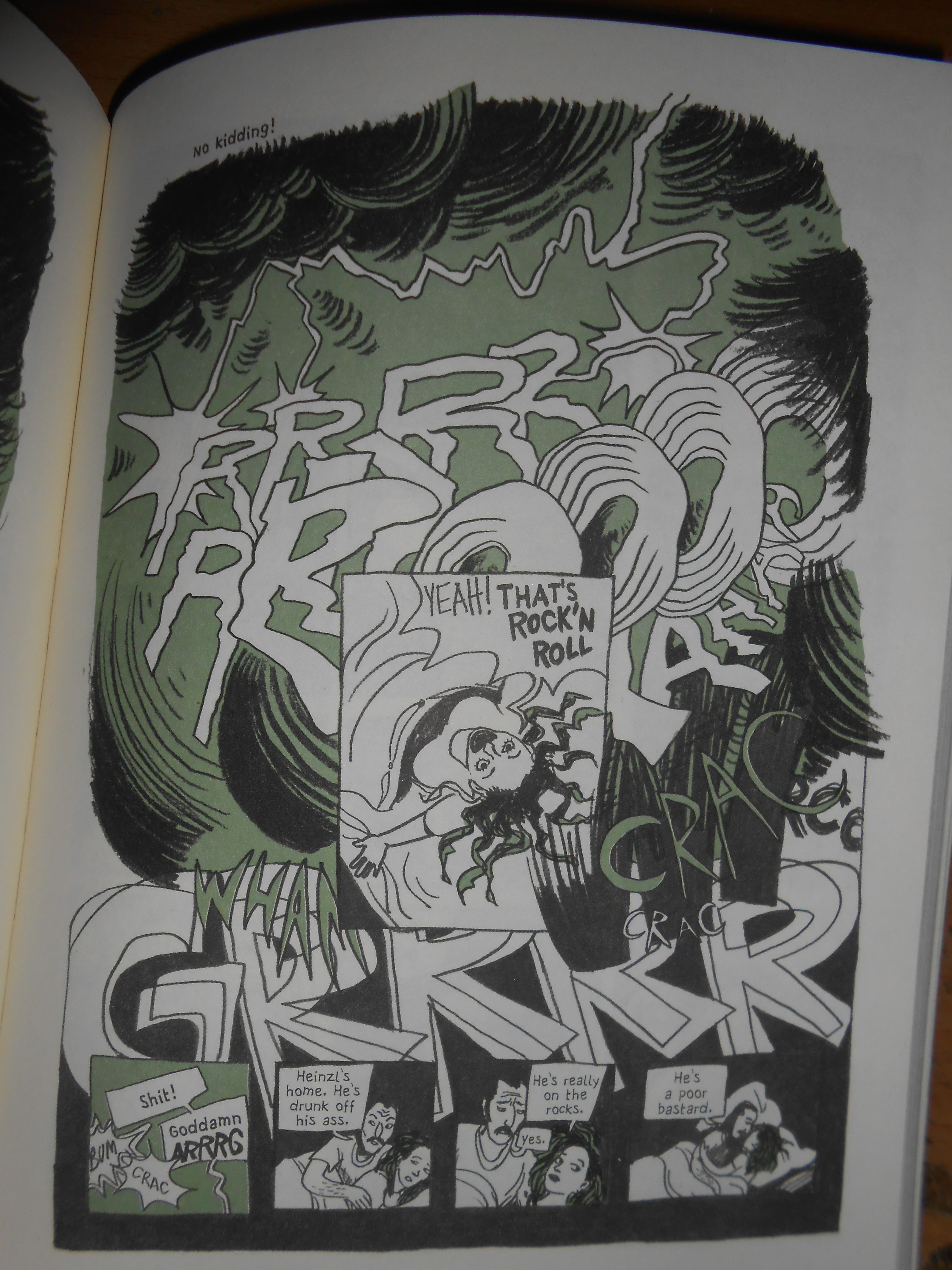
Lust uses a two-color gestural looseness to achieve an impressively swift readablility, an extremely appealing and expressive style that never strains for effect. And though it was drawn based on journals twenty-some years after the events it depicts, it has the feel of comics drawn on the fly, the hungry roughness of work done on the road. She uses a kind of gestural cartoon naturalism, dropping in details as they serve the story. Her style is pitch-perfectly changeless over a sprawling page count, and the strength of that communication and consistency allows her to violate it, sliding into abstraction at will. These are comics as memory, and they’re drawn from the inside out. Ulli is weightless, feet inches off the ground as she soars up and down Rome’s Spanish Stairs; her face balloons with rage when she’s condescended to by a well-meaning woman; her skeleton is visible through her body, like a walking x-ray, when she’s at her most vulnerable.
DSCN1476 (2)

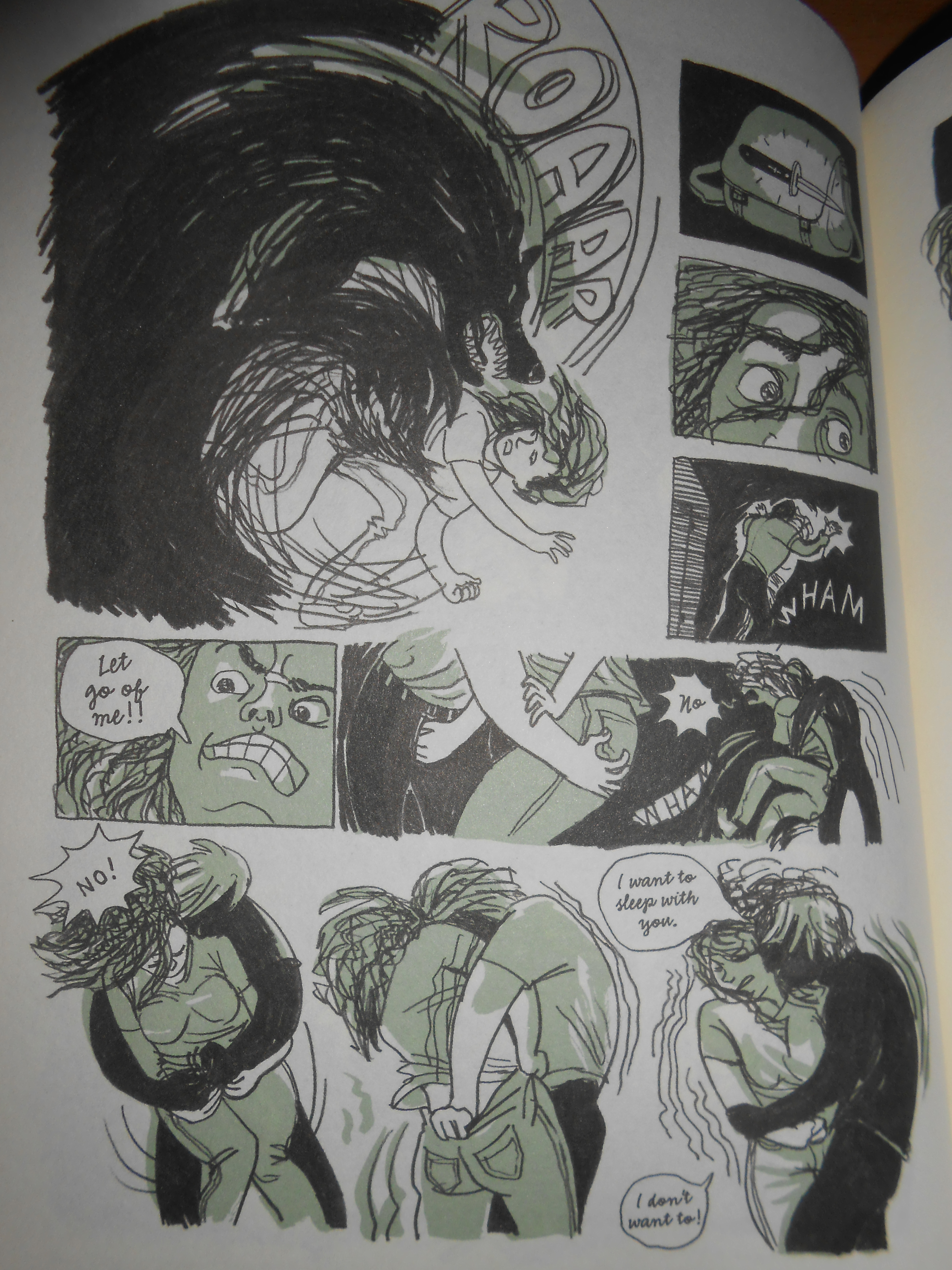
The theme of sexual violence becomes more prevalent as the story grows darker and more frightening, but it’s treated with such blithe acceptance that it desensitizes you. Ulli is infinitely, foolishly trusting, and will seemingly go anywhere with any man who promises a warm place to bunk down for the night. She’s repeatedly pressured into sex by what’s portrayed in the book as an Italian attitude that utterly normalizes sexual assault (any decent woman always says no), but she seems at first to regard it as no more than the cost of doing business. So when, against this background of quasi-consensual but utterly unappealing (and occasionally actively appealing but utterly disappointing) sex, she is violently raped — screaming, biting, struggling against this stranger who’s drawn as a featureless shadow-man against the darkness of her room — the effect is devastating.
DSCN1468

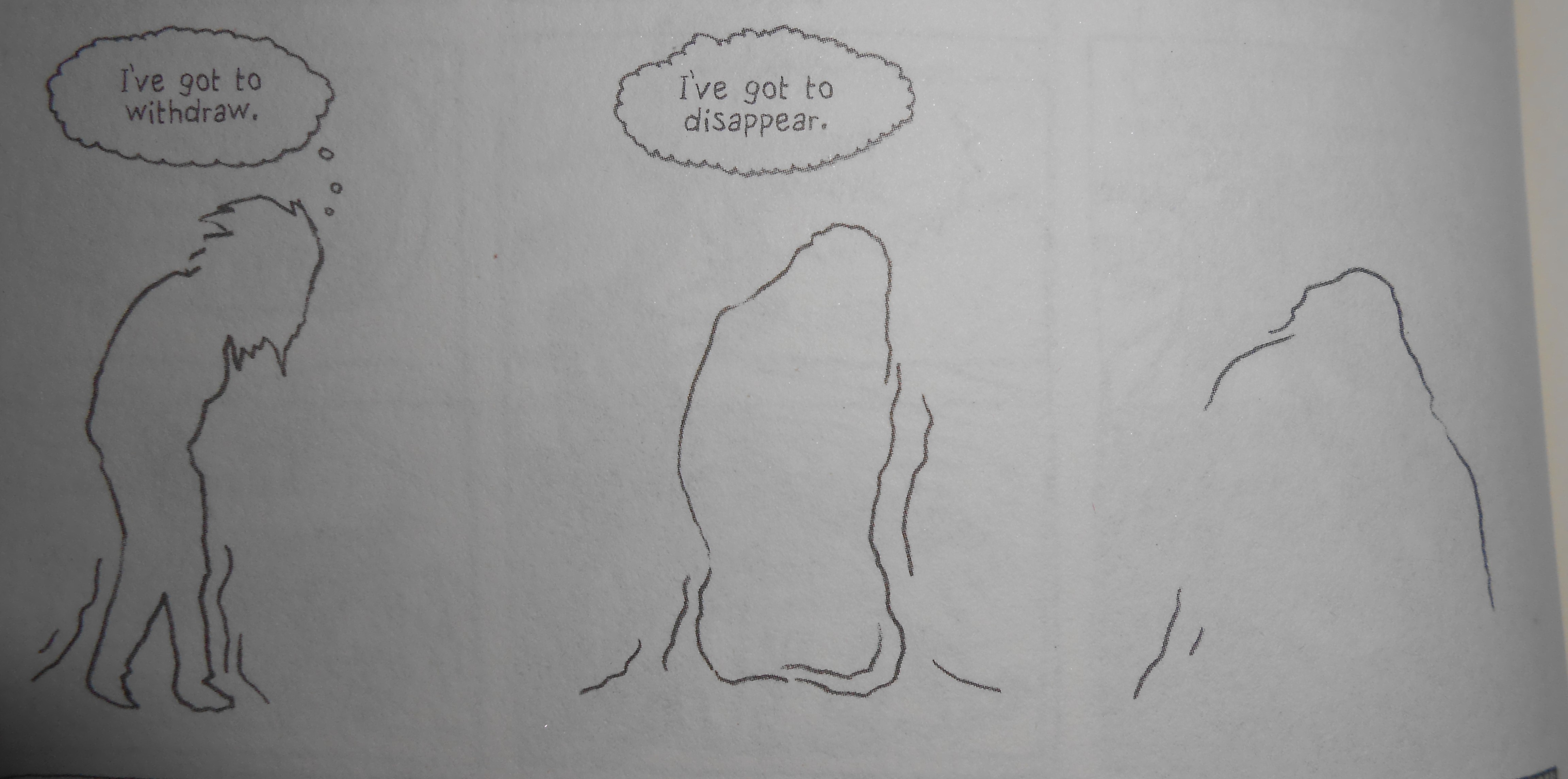
Her cartooning in the aftermath, the days following the attack, is heartbreakingly powerful. She draws herself as a translucent silhouette, moving along the fringes of a coastal town. In one astonishing three-panel sequence, she goes from a walking figure to an amorphous, huddled, human-ish shape before collapsing into four delicate, meaningless lines.
DSCN1464 - Copy (2)

That act signals a tidal shift in the book. Despite — or because of — her trauma, she ends up falling for her rapist, spending what looks a lot like an idyllic weekend with him on the shore, though he encourages her to whore herself to local men. She soon leaves for Sicily (the relative safety of cosmopolitan Rome is played against the savagery of the more traditional South), but the shape of the story is changed. What began as a thrilling, high-spirited adventure journal with an undercurrent of danger and sexual violence becomes a fearsome, damaged howl, a catalogue of abuse, drugs and destitution, and a vicious, terrifying indictment of rape culture in Sicily and beyond.
DSCN1465

But Lust’s tone never really changes — her wide-eyed excitement fades, but her casual attitude and insistence on continuing the adventure persist. Now long separated from Edi, she is alone, a helpless lamb among Sicilian wolves, but she learns nothing: she still trusts everyone, though they all turn out to be monsters, and never once considers returning to the bourgeois safety of Vienna until it becomes a logistical necessity.

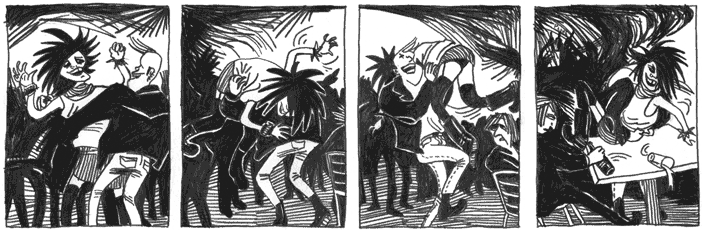
But even as the story darkens, begins to give itself over to brutality and addiction and betrayal, it never loses sight of the little observational shards of humanity that animated its first half, the interstitial pieces that are left out of most stories: the bummed cigarettes, the time-killing conversations, the little notebook she keeps of phrases useful for begging, her constant, sweet and hopeful seeking of other punks, as though anyone with a tattered shirt and a tattoo is her lifelong friend.
ulli punks

The events of the book constitute a non-stop assault on her dreamy innocence — the fact that she manages to mostly maintain it is both her most remarkable and her most infuriating characteristic. This version of Ulli Lust will always be frozen in motion as the wild young dynamo depicted here, shrieking with excitement in a thunderstorm, dancing to the Clash, leaping & flitting like a joyful spirit up & down the Spanish Stairs. Young, stupid, unbroken and beautiful.
DSCN1462

That’s the brilliance and the frustration of this remarkable book: it refuses to make an argument. Though the book’s content is overwhelmingly focused on sexual violence, it never underlines any larger point. Ulli is going through a nightmarish itinerant existence as a homeless quasi-prostitute, and she never considers simply walking away. You never quite forget that this middle-class Austrian girl is making the choice to go through this horrifyingly degrading lifestyle to which so many women of another social status are doomed. The first time she knowingly sells her body it’s to a mournful older man who gives her her most satisfying sexual experience. He looks at her with sad, wet eyes, she thinks he has a beautiful cock, and they fuck with real passion. Her tenderest relationship is with the heroin junkie pimp who rents her out. He talks to her like a person, respects her boundaries, and helps her find her way to her first orgasm.

This is heavy, baffling stuff, and it’s hard to know what to make of it — like it’s hard to know what to make of anything when you’re seventeen. By showing us her victimization without ever asserting her victimhood, by showing us her descent into destitution and homelessness without denying her entitlement, the youthful foolhardiness and privilege that allowed her to make this mess of her life, Ulli Lust has created an astonishingly honest & open-hearted graphic recollection.

The back cover copy calls it a “coming-of-age narrative.” It’s no such thing. It’s a being-young narrative, with no distilled lessons or readable character arc. Lust is not writing as her forty-something self — she is cartooning from within her adolescent experiences. If you come to this book looking for the pleasures of memoir — the wisdom gained, the wry comment, the journey through pain and the hopeful way forward — you will be disappointed. So come to it with nothing — no expectation and no judgement. You will find the soul of a young woman, battered & foolish, kind & hopeful, ragged but not torn, pressed like a flower between its pages.
DSCN1467– Josh O’Neill

good this week

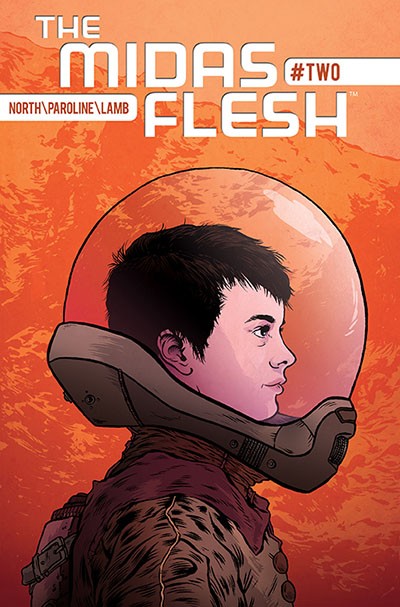
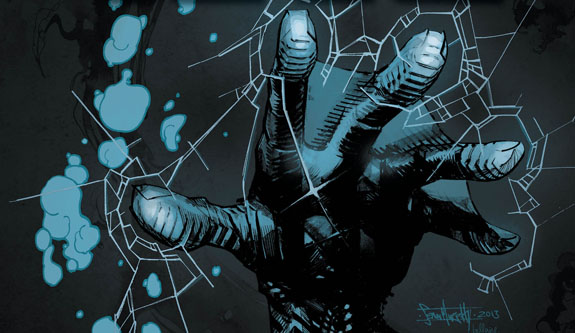
the midas flesh #2 : i missed the first issue of this charming little sci-fi series from the creators of the ADVENTURE TIME comic. with a solid gold concept, breezy dialogue, and pleasing, clean art, this book was a nice surprise and one i’ll be looking out for from now on.

Image

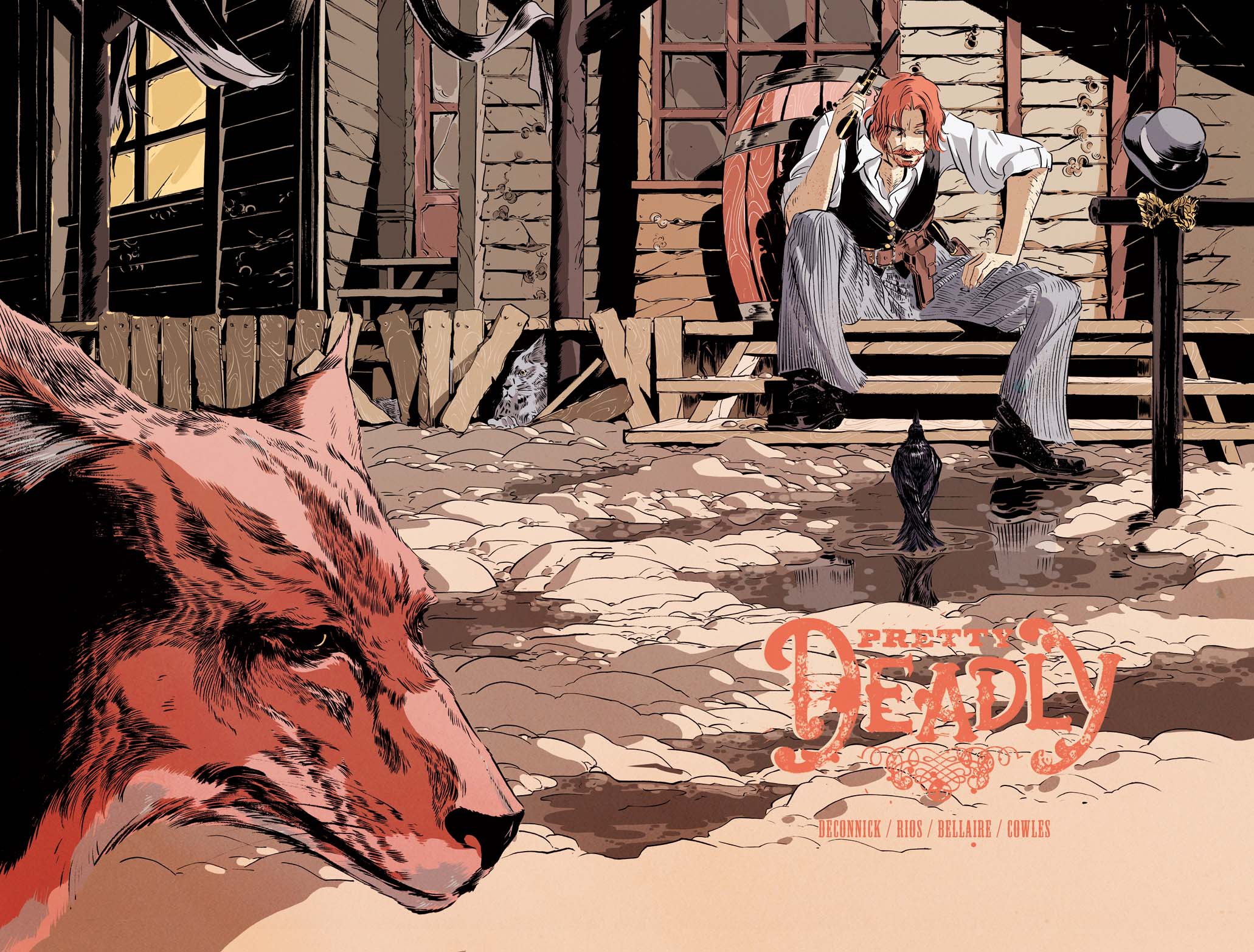
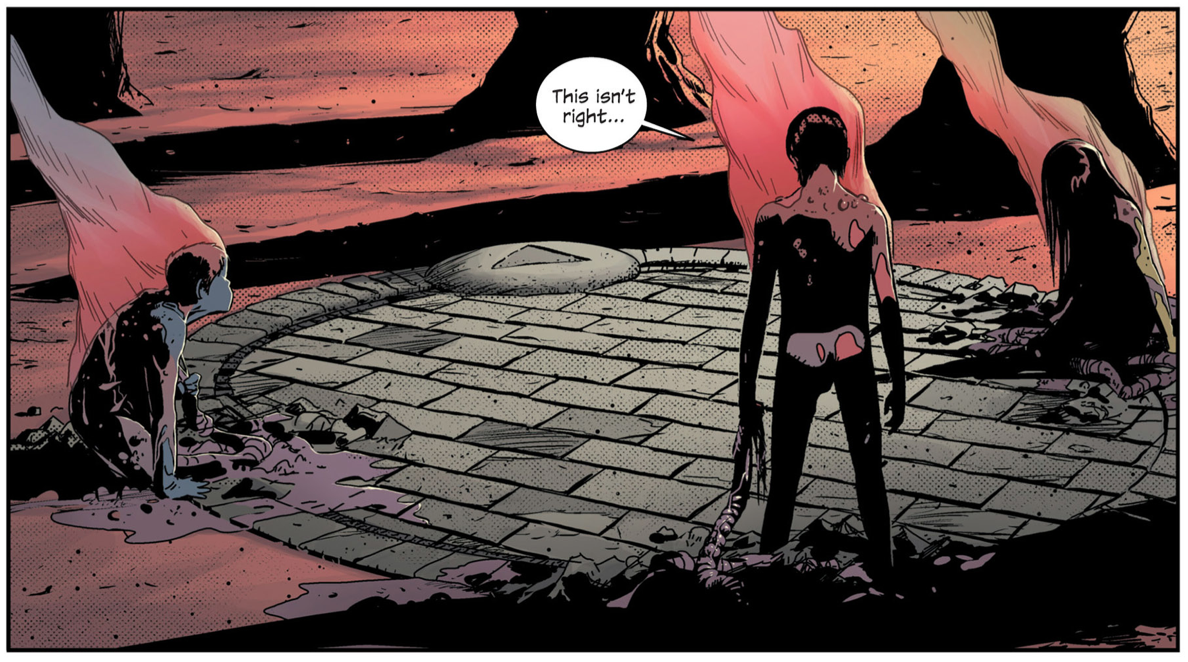
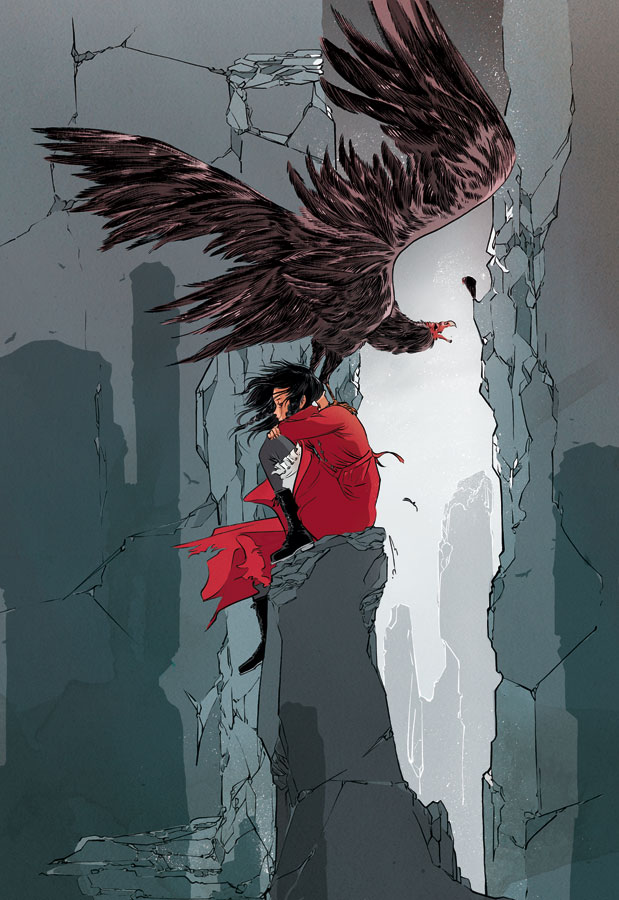
pretty deadly #4 : another magnetic issue from a sure-fire series of the year candidate–and we’re less than a month in. this issue sets things up for a walloping climax to the opening storyline.

Image

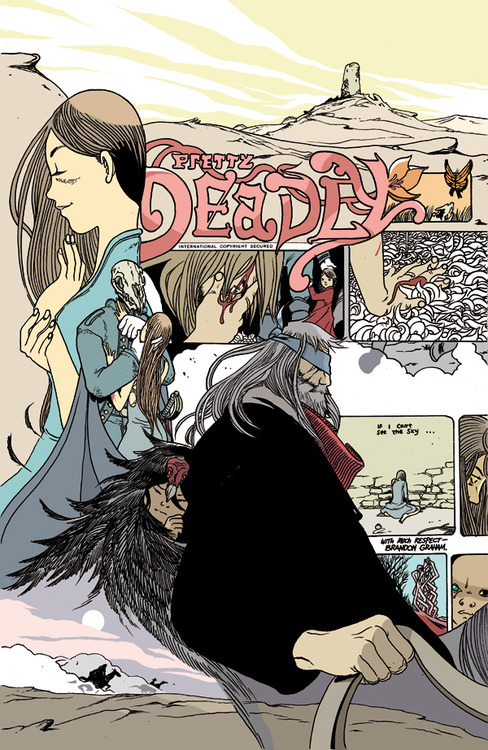
there’s also a killer brandon graham pin-up…

Image

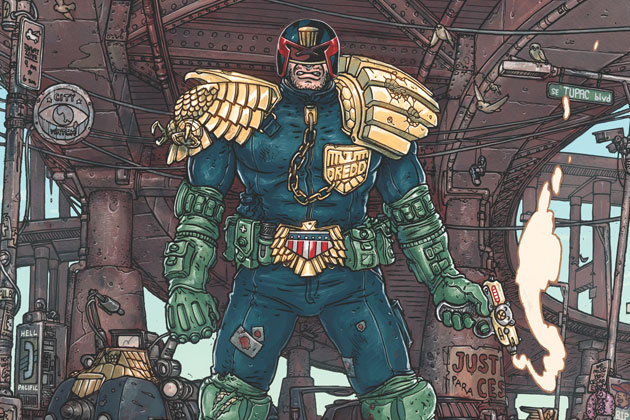
judge dredd mega city two #1 : the venerable judge steps into a wacky west coast version of mega city that’s modern day L.A./hollywood to the max. but what really matters here is ulises farinas’ crazy-in-the-best-way artwork. i haven’t had so much fun poring over background details since zander cannon and gene ha delivered the goods in alan moore’s TOP 10. mixing insane detail with hyper-clean lines, ulises brings his A game and firmly announces himself on the scene.

Image

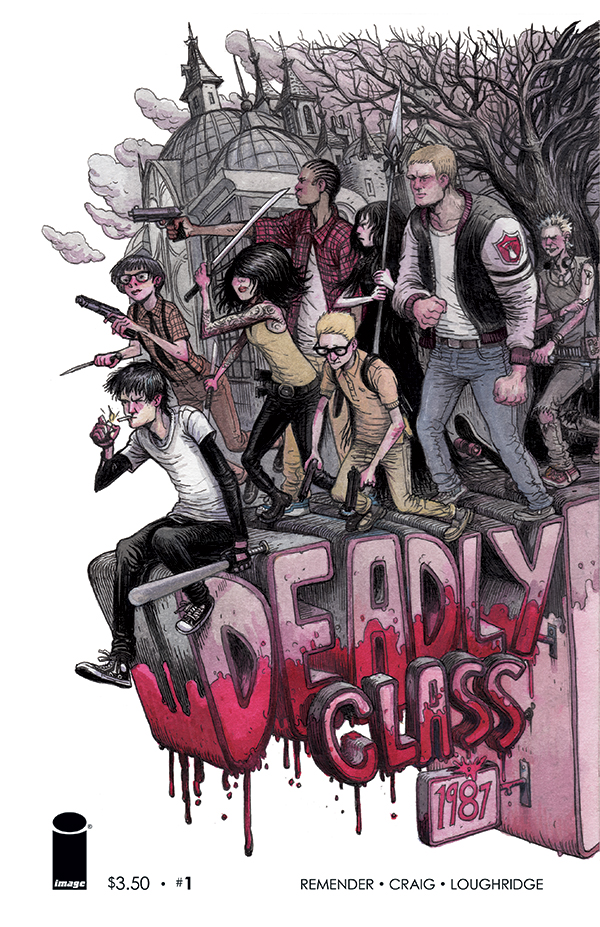
deadly class #1 : rick remender and wes craig kick up some dust in this elegantly designed & drawn entry into the teenage assassin club genre, with the twist being this feels kind of like an inverted real-ish world original x-men. let’s see where it goes.

Image

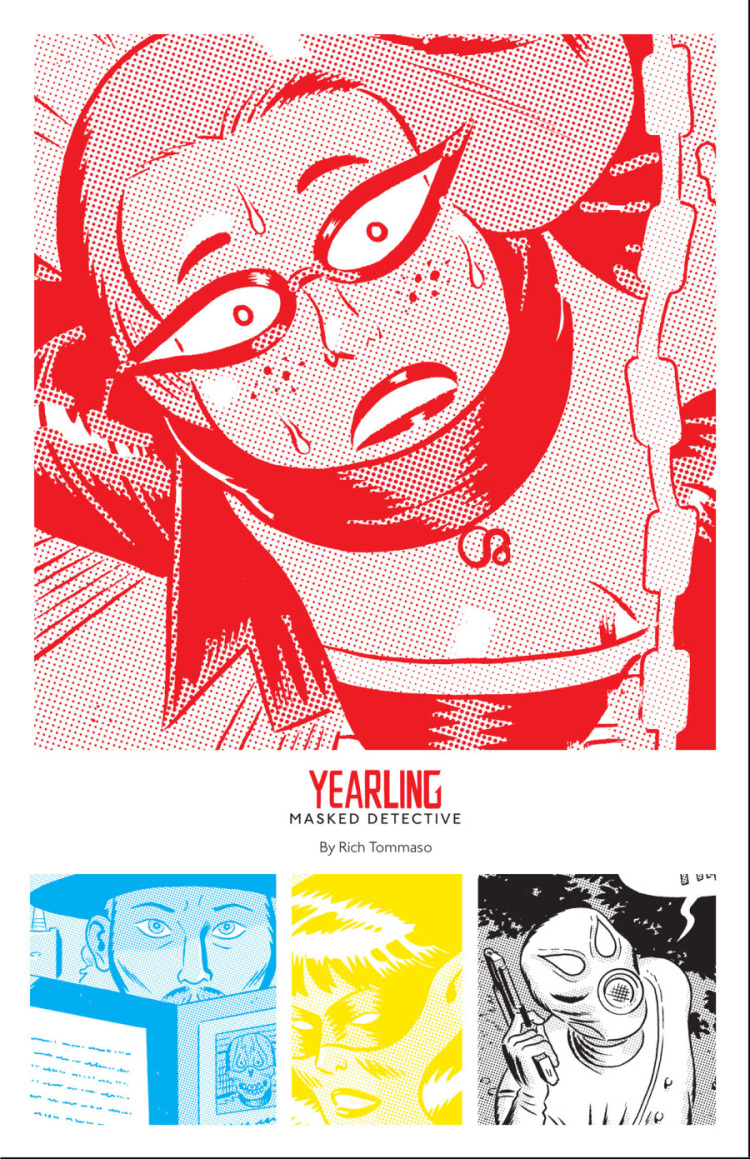
yearling masked detective #1 : rich tommaso’s super avenger crime series kinda reminds me of a straight-edge, non-team version of COPRA that’s more interested in dan clowes than jack kirby and frank miller. with a 1st issue that’s all set-up i’m curious to see where he takes it.

Yearling-richtommaso

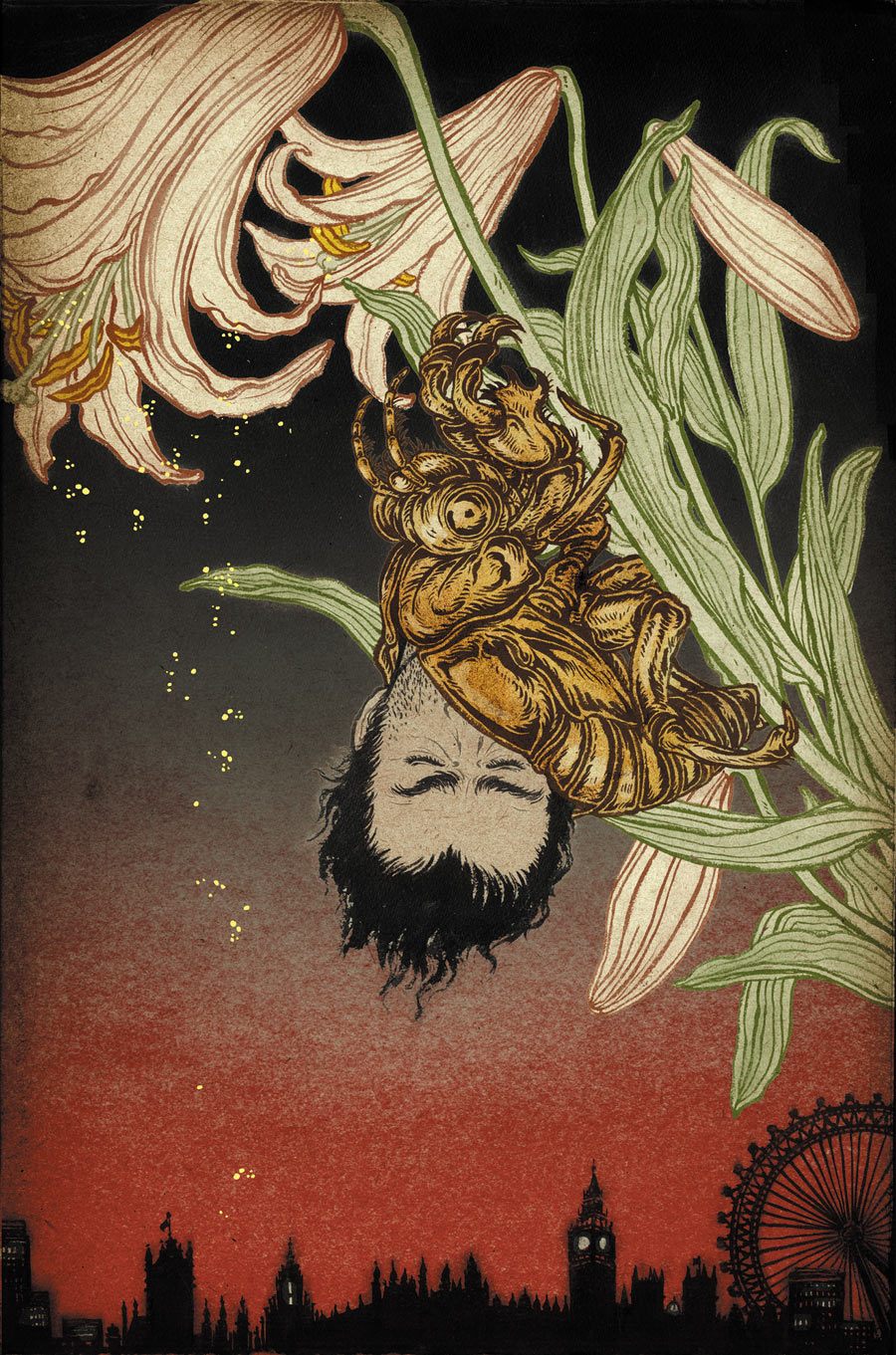
unwritten apocalypse #1 : as one of the best modern day vertigo series looks into the light at the end of the tunnel, it’s a good time to celebrate what mike carey, peter gross, and yuko shimizu have accomplished. get into it, whether you start here or with volume one.

Image

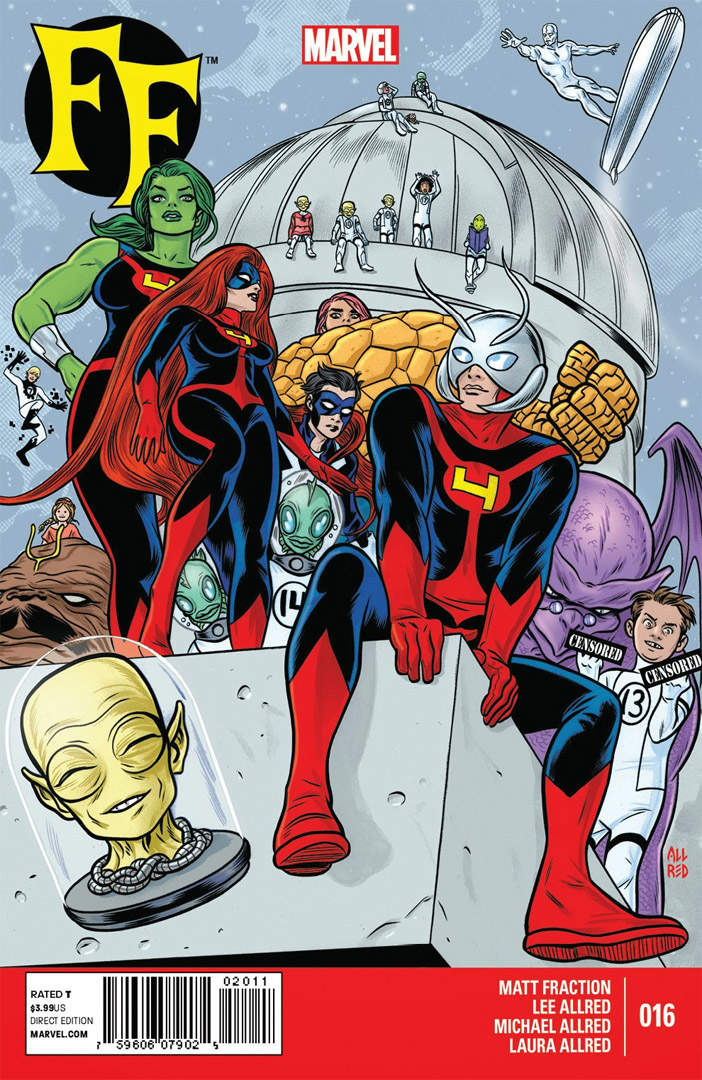
ff #16 : sad to see this book come to an end, but it’s a glorious end, with 15 extra pages of art from mike & laura allred and all the character moments and then some that you’ve come to expect from this first rate series. one of the more endearing marvel books of the last decade.

ff16cover_allred

–chris stevens

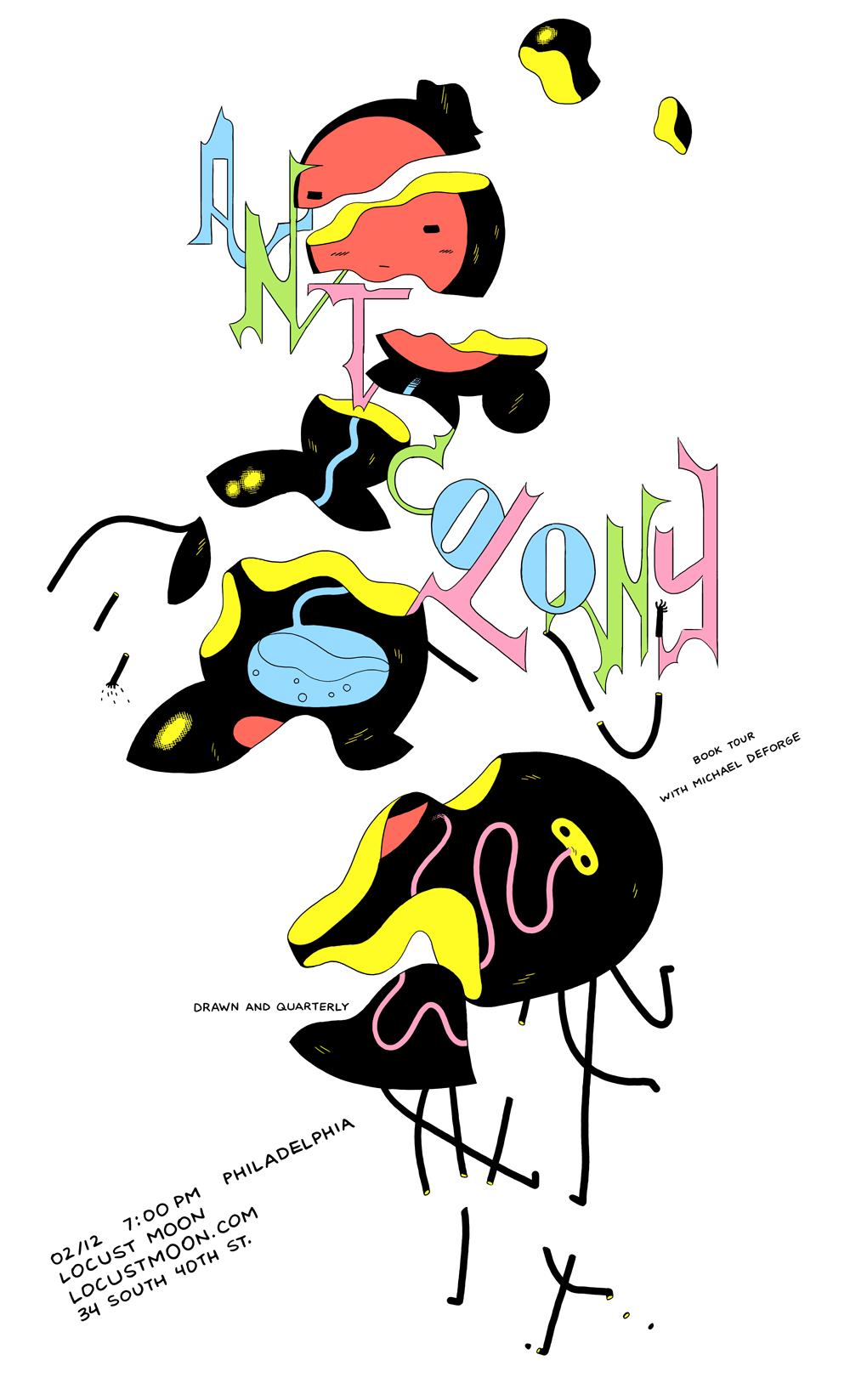
An Evening with Michael DeForge

On Wednesday, February 12th, Locust Moon will be hosting the launch of Michael DeForge’s darkly existential graphic novel Ant Colony. In just a few short years, DeForge’s singular, idiosyncratic style has made him one of the most exciting new voices in alternative comics. Here, he will present a slideshow with a reception to follow. Drinx, snax & comix.

anttour-philly

Ant Colony follows the denizens of a black ant colony under attack from the nearby red ants: from its opening pages, DeForge immerses the reader in a world of false prophets, unjust wars, and corrupt police officers. On the surface, Ant Colony tells the story of this war, the destruction of a civilization, and the ants’ all-too-familiar desire to rebuild. Underneath, though, Ant Colony plumbs the deepest human concerns – loneliness, faith, love, apathy, and more. DeForge’s striking visual sensibility – stark lines, dramatic color choices, and brilliant use of page and panel space – stands out in this volume.

SWAMP THING by Vaughan and Petersen

ST1

Brian K. Vaughan has, in the last 15 years, become something of a comic-world King Midas. Already wreathed in laurels from his work on Y THE LAST MAN, EX MACHINA, PRIDE OF BAGHDAD and Marvel’s RUNAWAYS, he’s spent the last couple of years perfecting his golden touch on the gloriously intimate epic SAGA, which has basically won every award there is including the Nobel Peace Price and the Oscar for sound design, and the webcomic THE PRIVATE EYE, with its visionary hey-just-pay-me-whatever business model and sizzling, compulsively readable story. (When you can make a lot of money by simply giving things away, you are in a rare and enviable position.) These are shaping up to be his two finest works with his two greatest collaborators, Fiona Staples and Marcos Martin respectively. Vaughan has already reached the top of the comic-maker mountain, but his ascent continues.

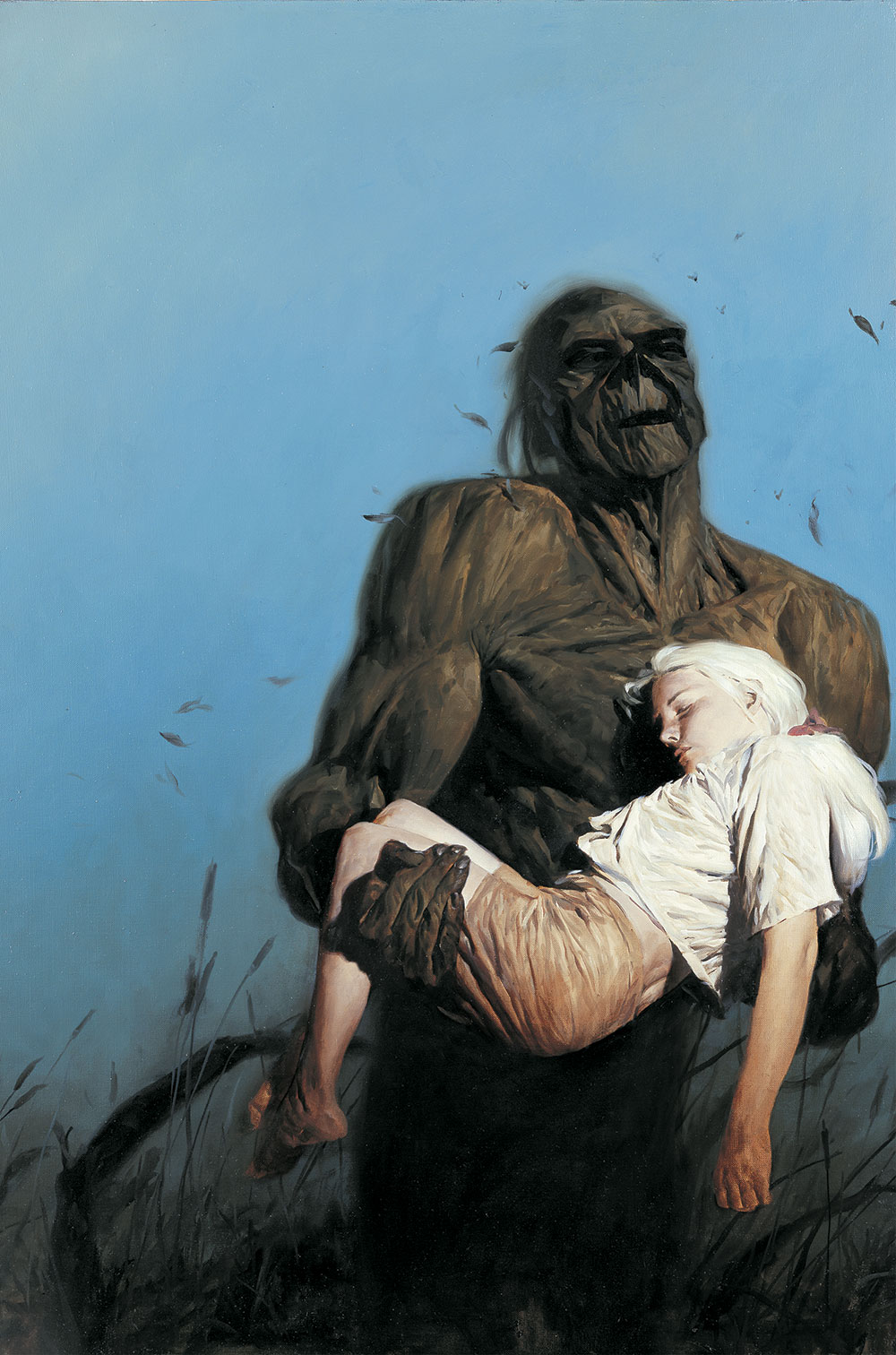
And thus we have a newly-collected edition of Vertigo’s little-remembered 2000 SWAMP THING series, a book that largely flopped upon release. I’m not sure why — it’s a pretty terrific comic in its own right. It’s a little ironic, though, that it’s been branded in large text on the cover, spine, and back as SWAMP THING BY BRIAN K. VAUGHAN, when it’s in fact a document of a gifted young writer who’s just starting to find his way, collaborating with a stellar but mostly unknown cartoonist at the very top of his game.

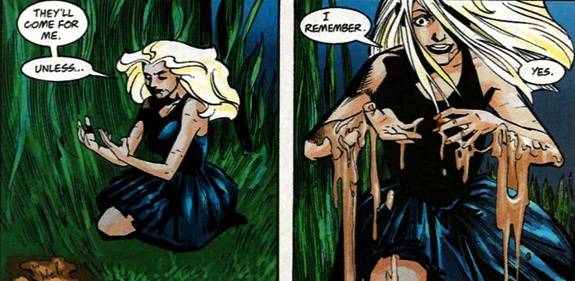
Roger Petersen has lineage on his side. He’s the grandson of the legendary EC cartoonist George Evans, and the echo of Evans’ clean, expressive precision can be found in Petersen’s effortless line-work. Anyone drawing a Swamp Thing title is going to be working in the long shadow of Wrightson, Totleben and Bissette — Petersen deals with this by running in the opposite direction, away from the obsessive, overgrown undergrowth of detail that characterized the stories of Alec Holland, towards a sleeker, more gestural style given full voice by the sharply minimal inks of Joe Rubenstein and the subtly bold colors of Alex Sinclair.

ST2

Which is a fitting choice, because the stories in this collection are about a younger, angrier, more human Swamp Thing. Tefe Holland is Alec’s daughter, a young woman adrift & searching, commanding & self-confident yet unsure of her own nature or agenda. She has no real allegiance to man or plant, though she inevitably ends up serving (and killing) both. She’s faked her own death, through plot contrivances too convoluted to mention here. (Vaughan spends the first two issues trying and not-quite succeeding to write his way out from under 30 years of continuity, and it’s here more than anywhere else that you see the talented writer struggling to master a generic language — it may be no accident that Vaughan’s major triumphs are all books starring how own original characters.) These stories are somewhat old-fashioned — stand-alone adventures, heavily compressed, each with a traditional structure, a moral dilemma for Tefe, and a satisfying resolution. The serial aspects build slowly, without straining for effect, to answer the central question posed by the series: who is Tefe Holland? Is she an impulsively angry young woman who makes mistakes and selfishly hurts people? Or is she a violent force of nature, barely held in check by a scrim of humanity? She is animated by rage and by conscience, but which one is at her core?

There are real guts in his depiction of Tefe. Where a lesser writer may have pitched a character’s conflict along the same lines — vengeance vs. conscience — very few would have the courage to make her an amoral murderer as well as a hero. That courage, in fact, may speak to the poor reception of the series — we’re being asked to identify with this character who is clearly something other than human, who has few qualms about executing people for the crime of chopping down trees. But she also has a deep, instinctive compassion and empathy that is just as compulsive as her fury. She is a metaphor for nature: that which nourishes is also that which kills. It makes for a bafflingly complex protagonist, if not for a likable one. That courage, that resistance to reader-identification (along with the deeply confusing slog of an info-dump in act one), may be partly to blame for the book’s poor initial reception, but I found it fascinating. Like he did with EX MACHINA’s Mayor Hundred, he uses a serial structure to gradually try to tease some truth out of a character who’s always in motion, who seems to deflect our gaze.

Whereas this series is a forgotten footnote in the apotheosis of Vaughan, it was Roger Petersen’s biggest appearance on comics’ main stage. As good as Vaughan’s storytelling already is here, there is awkwardness and over-explanation and some dialogue that is too-clever by half. These missteps are easily papered over by Petersen’s highly developed cartooning voice, which is strong and funny and rhythmic, simple yet rich, with the fully realized environments that are necessary in a continent-crossing road-trip story like this. Most importantly, it reads with a rare and effortless music that provides a perfect platform for Vaughan’s text-heavy, morally knotty story.

Petersen is a colleague, a collaborator and a hometown boy. He mixes up a hell of a Manhattan at Fishtown’s Atlantis pub and does illustration work for a wide variety of clients. His art, which needed no improvement, has gotten much better in the last decade and a half. We are extraordinarily proud to feature his beautifully yearning strip in our upcoming book LITTLE NEMO: DREAM ANOTHER DREAM.

I hope this SWAMP THING edition does gangbuster sales — there are still eleven uncollected issues, and I’d really like to read them.

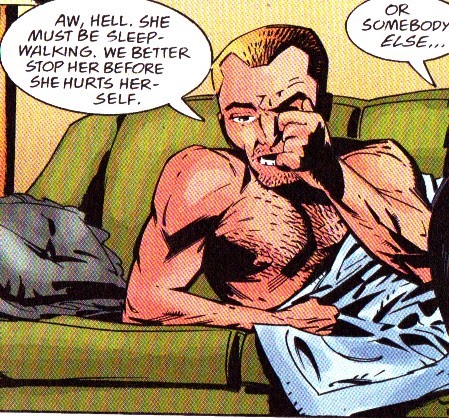
* Wondering why I go on and on about Rog Petersen’s cartooning and there’s none of it to be seen? It’s because my scanner is broken, and there doesn’t appear to be any artwork from this book online, except the two panels shown above, and this random panel of a guy without a shirt (which I’m not even 100% sure is Roger).

ST3

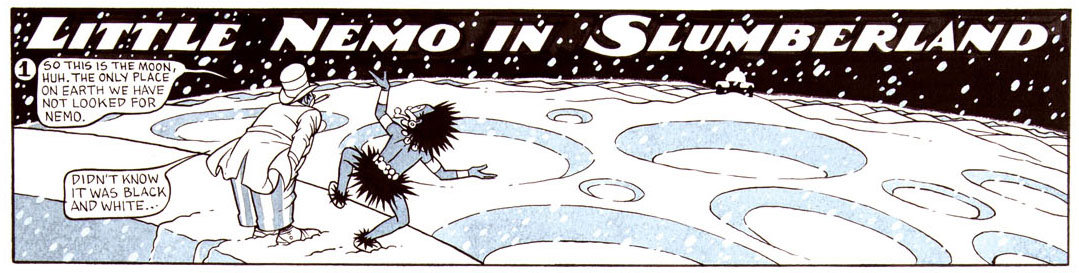
Instead, I’ll show you what I’ve got: the gorgeous first panel from his LITTLE NEMO strip.

LittleNemo_LocustMoon_RogerPetersen_Panel

Flip and the Imp on the moon. As good as his grandad.

– Josh O’Neill
good this week

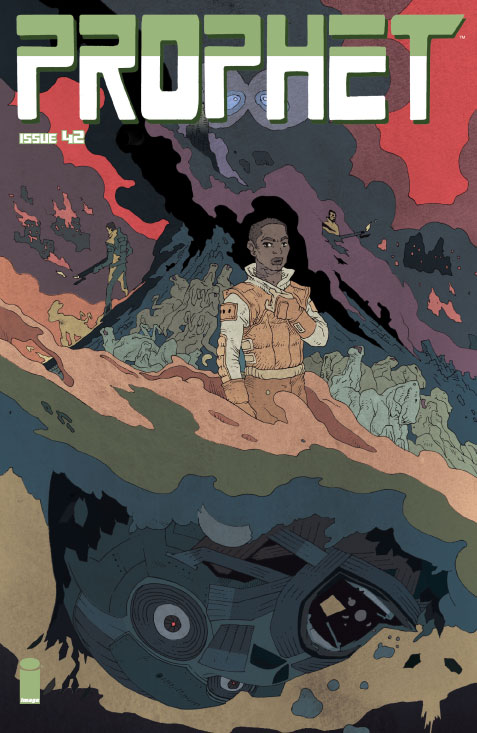
prophet #42 : ron wimberly jumps in and delivers one of the best issues of the entire turned-on-its-head relaunch led by brandon graham & co.

Image

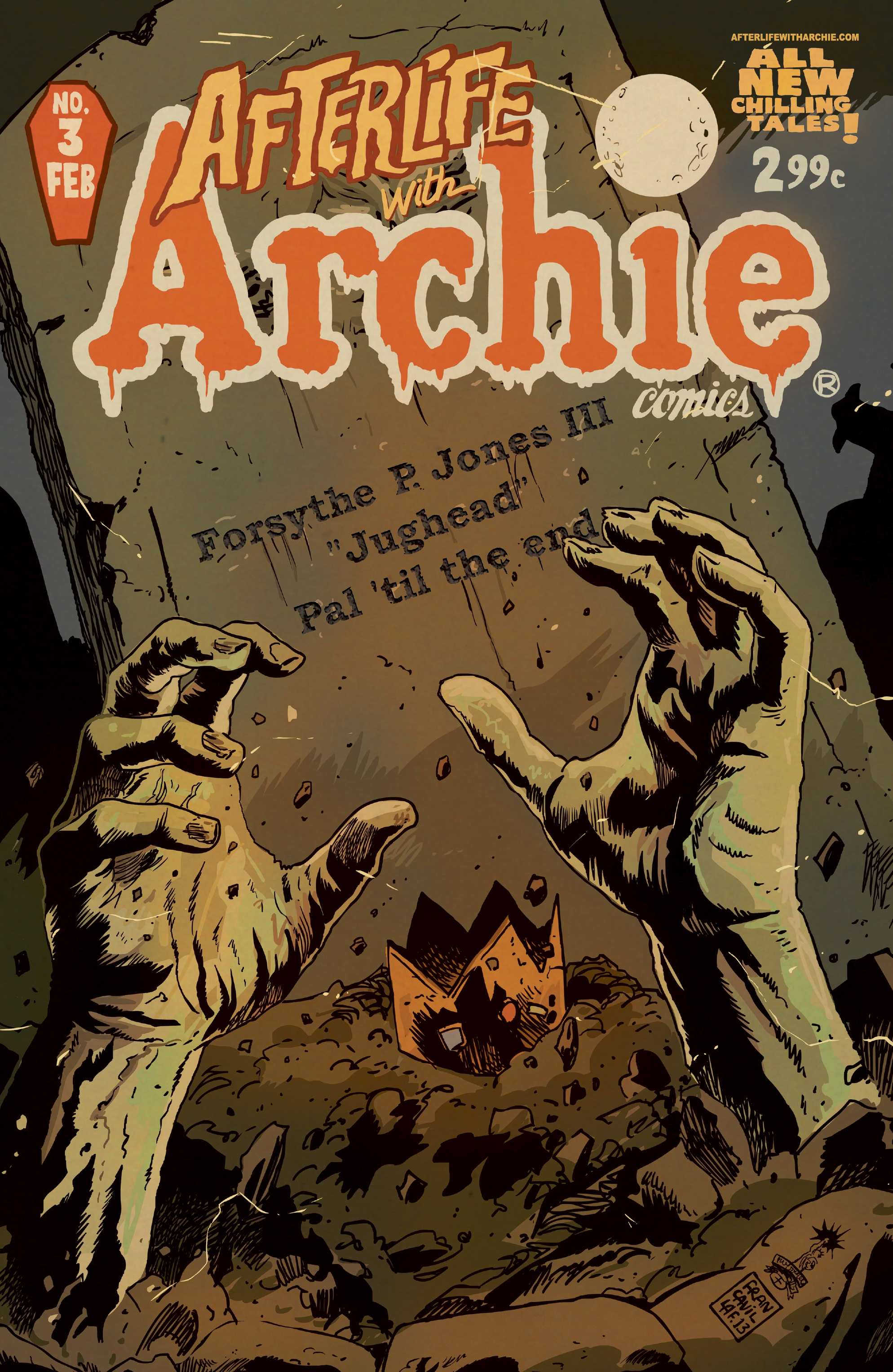
afterlife with archie #3 : the most improbably awesome book of the year rolls on.

Image

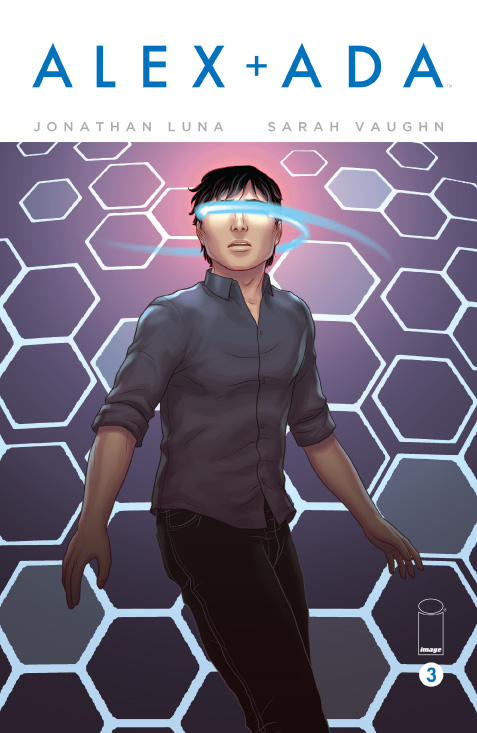
alex + ada #3 : the romance heats up!

Image

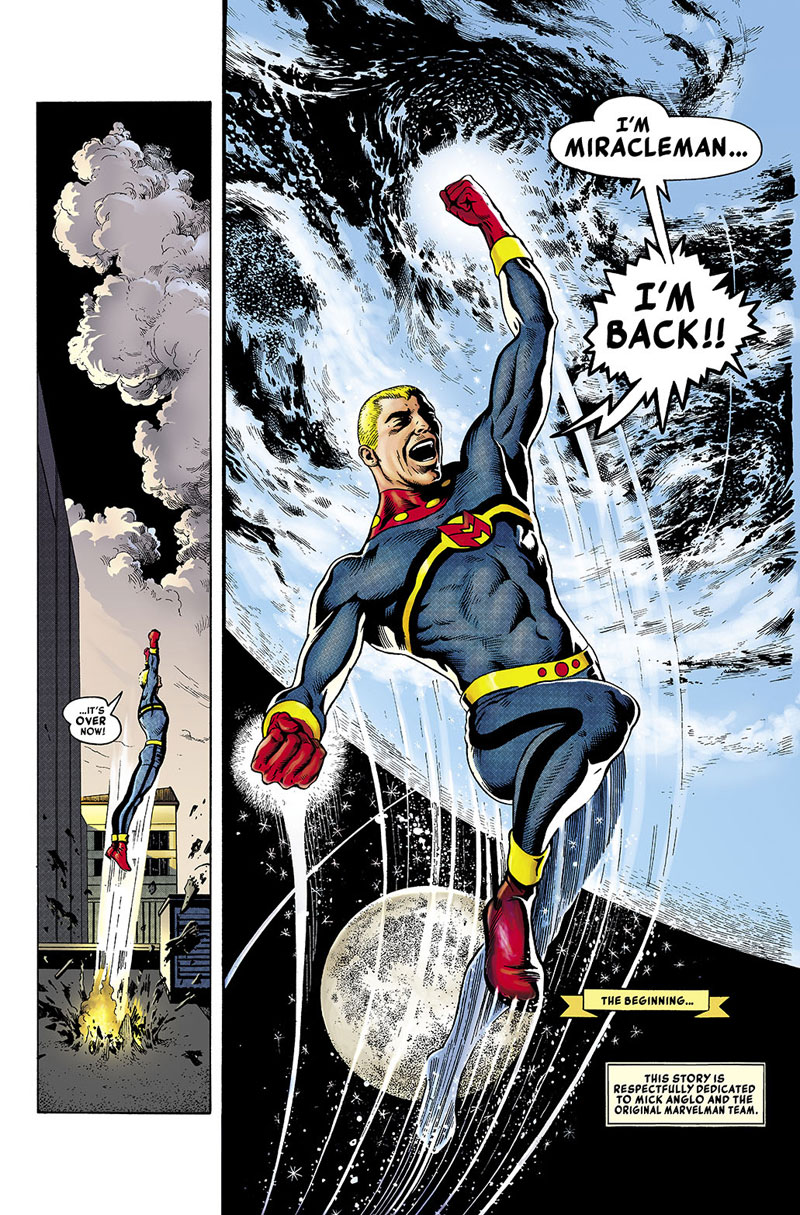
miracleman #1 : one of the greatest and most influential superhero comics of all time is also one of the least read due to over 20 years worth of legal shenanigans. but starting here alan moore’s masterpiece rolls out monthly.

Image

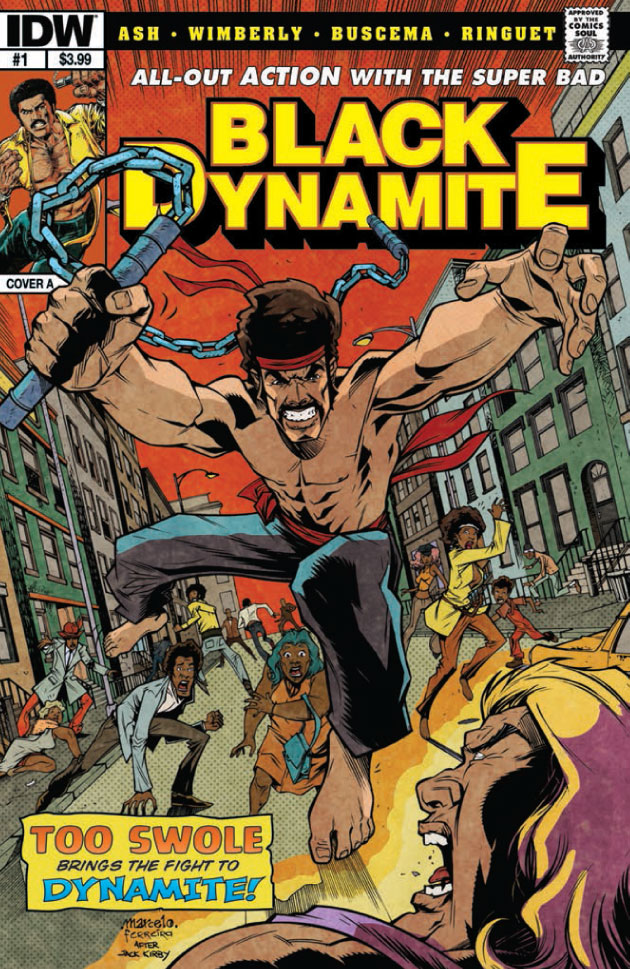
black dynamite #1 : ron wimberly double dips this week, here providing the kinetic pencils that fuel this blaxploitation-era romp.

Image

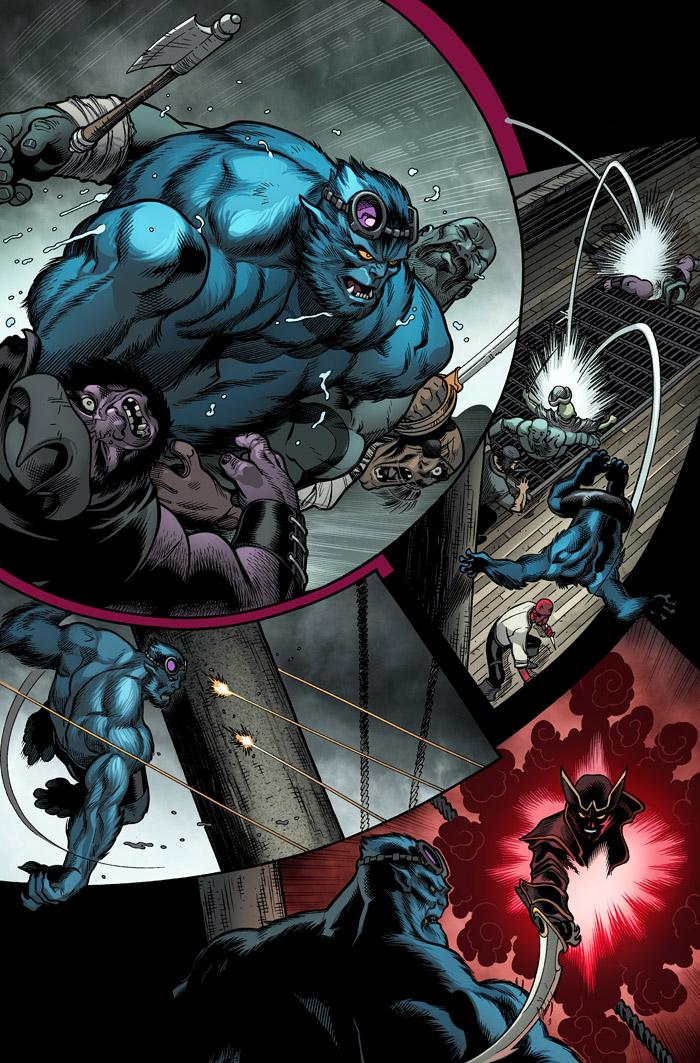
amazing x-men #3 : bamf! more ed mcquinness goodness.

Image

–chris stevens

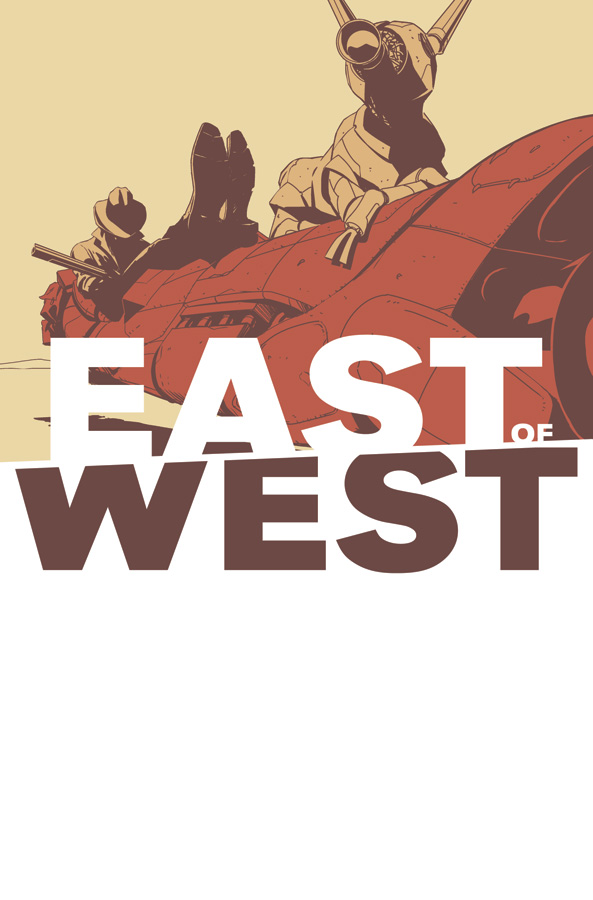
East of West, by Hickman & Dragotta

east

East of West seems almost custom-designed to foil synopsis, but here’s me trying: it takes place in 2049 in an alternate America that was wracked by extensive civil wars, and has split into seven nations, including the Confederate States, a unified Endless Indian Nation, and New Shanghai. Somehow these seven nations, or at least a number of their highest-placed members, share a holy text — a pieced-together book of enigmatic apocrypha called The Message, which details (and immanentizes) Armageddon.

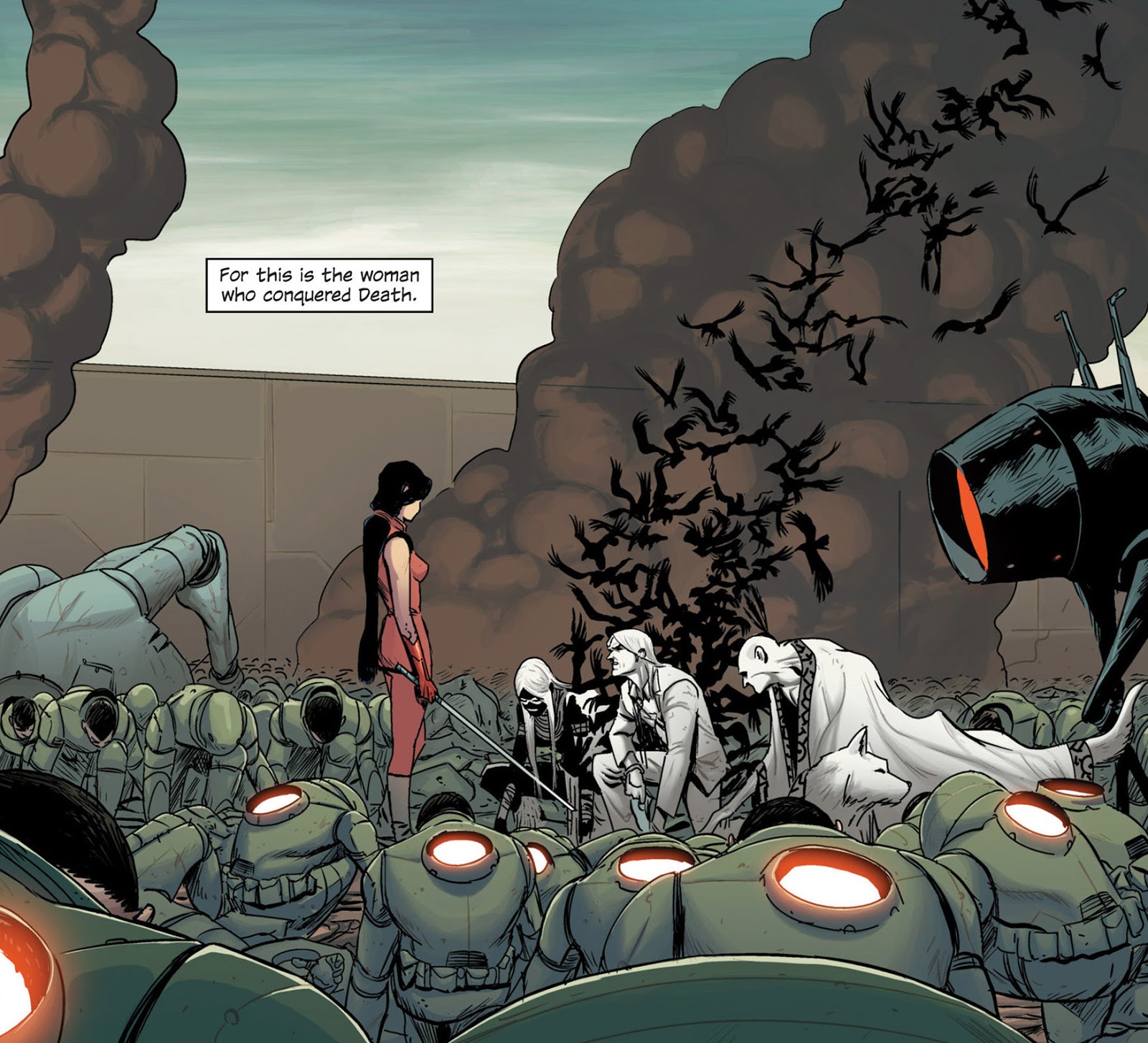
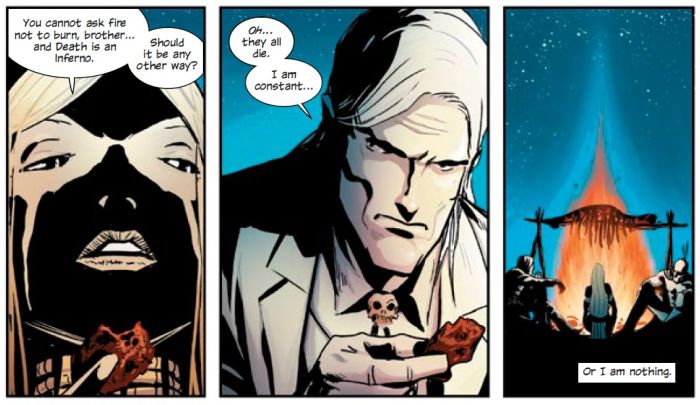
Jonathan Hickman’s richly layered story begins when, as foretold in The Message, the Horsemen of the Apocalypse awaken, embodied as children and eager to bring about the endgame, but surprised to discover that they are only three. Death, it seems, has broken off on his own.

East-of-West-Three-Horsemen

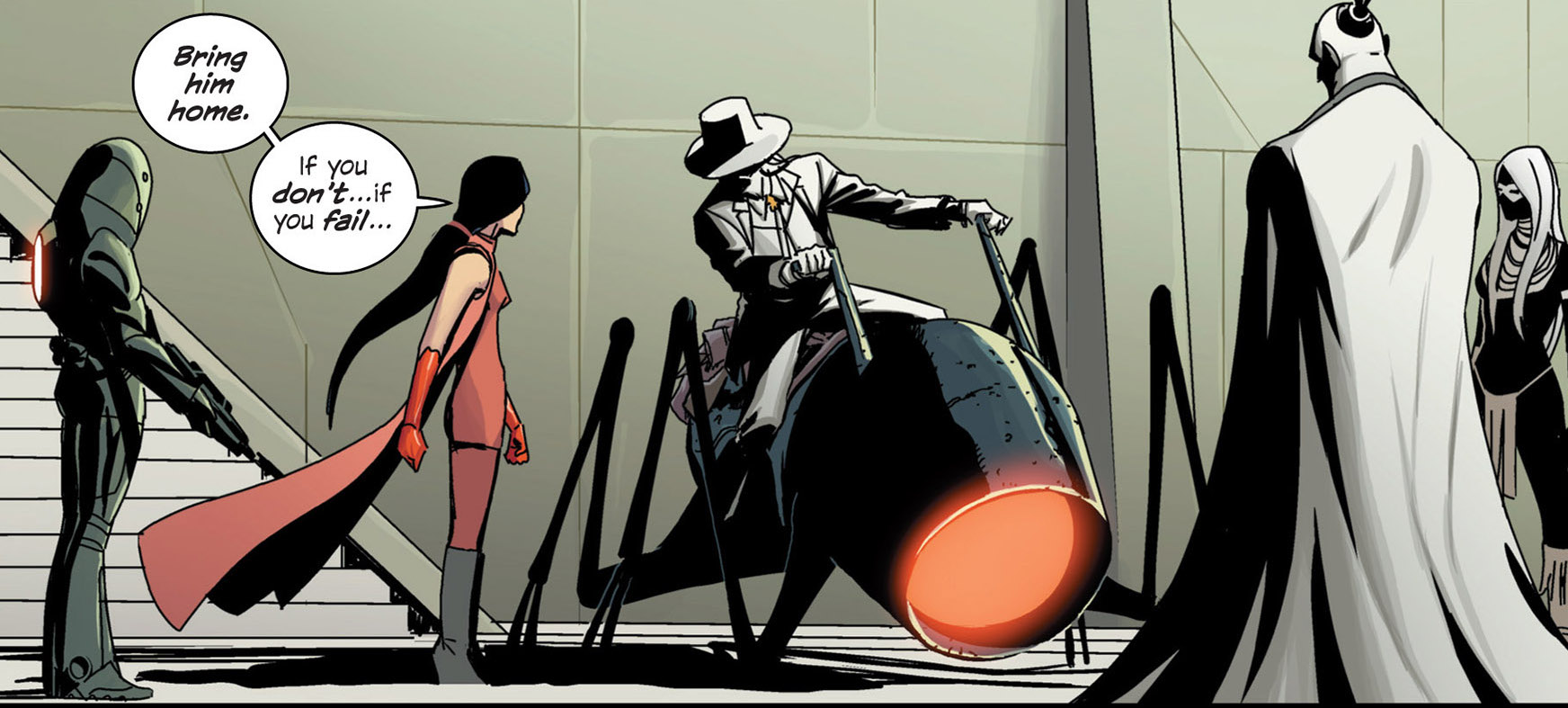
He’s riding a pale robot-horse across the seven nations, murdering acolytes of The Message in key positions. At first, his purposes are oblique, but soon become clear: Death is actually a little bit of a sap, and he’s trying to track down the woman he loves, who once loved him back.

east_of_west_004-024

Like Emma Rios and Matteo Scalero, Nick Dragotta is a highly skilled and promising professional who’s done a fair amount of work for the big two and then taken a quantum leap into auteur cartooning with an astonishing new Image series. Books this vital bring new meaning to the phrase ‘creator-owned’ — not just the intellectual property but the voice itself, so fully developed and alive on the page, the world-building so immersive, so effortless and thorough, that it’s impossible to imagine anyone else drawing it. This is a cartoonist’s voice in perfect tune with the subject matter, the space where the stark lyricism of John Ford meets the hard, cold sheen of Ridley Scott. Dragotta can take something as silly as a cowboy riding that aforementioned robot-horse with a laser cannon for a face and render it so artfully, so matter-of-factly, that you don’t blink.

east_of_west_005-023

East of West is a baffling book, and it demands rereading. It wants to be puzzled over and dissected like an esoteric text. Why, for instance, does a book set in a shattered and rejiggered United States never offer us a map of the new territory?* Because it wants to disorient us, is my guess. It doesn’t just want to tell a story about the wild west — it wants to BE the wild west, a mapless, trackless wilderness in which we have to find our own way. It’s the worst of both worlds, the lawless west and the sci-fi distopia — the desolate unsafety of the uncharted territory meets the tight social net in which we’re all pawns of forces beyond our control. The tension between security and freedom has been resolved by eliminating both.

So what we have on our hands at first appears to be some kind of retro-futurist hard-science gnostic political-intrigue western. But Death’s longing to be returned to his wife and child are the hook on which the wild digressions and house-of-cards world-building of the series are hung. Death is what passes in this book for a protagonist (if a story this huge in scope and this resistant to reader-identification can even be said to have one), and he has a formality, a slow, lanky, Gary Cooper courtliness at odds with the river of carnage he leaves in his wake.

East-of-West-2-INT1

There is something appealing about him. The characters in East of West are motivated occasionally by lust, or greed, but mostly they are motivated by pure grievance and hatred. The only true cooperation in the book is an uneasy collaboration among sworn enemies in the interest of burning the world to the ground. It is never explained, at least thus far, why they want to bring about the end times — but in a world this dead-eyed, this calculating and vicious, it doesn’t seem totally counter-intuitive. Death, though just as violent and selfish as the rest of the characters in East of West, is motivated by devotion and ardor. So it turns out that East of West is a soul-sick romance, with a sense of strangled longing that pierces like an arrow through its huge, dark expanse. For all of its futuristic trappings and alternate past, it is about our modern world: irredeemable, possessed by hatred and avarice and resentment, seemingly on the verge of toppling into ruin, yet still, against all odds, animated by the capacity for love.

*As Rick and Justin pointed out in the comments, there IS in fact a map included in an early issue of East of West. I must have missed it the first time through, though, and didn’t see it in my recent re-read of the trade. I fully embrace the confusion that’s ensued!

– Josh O’Neill
CELEBRATED SUMMER by Charles Forsman

CB cover

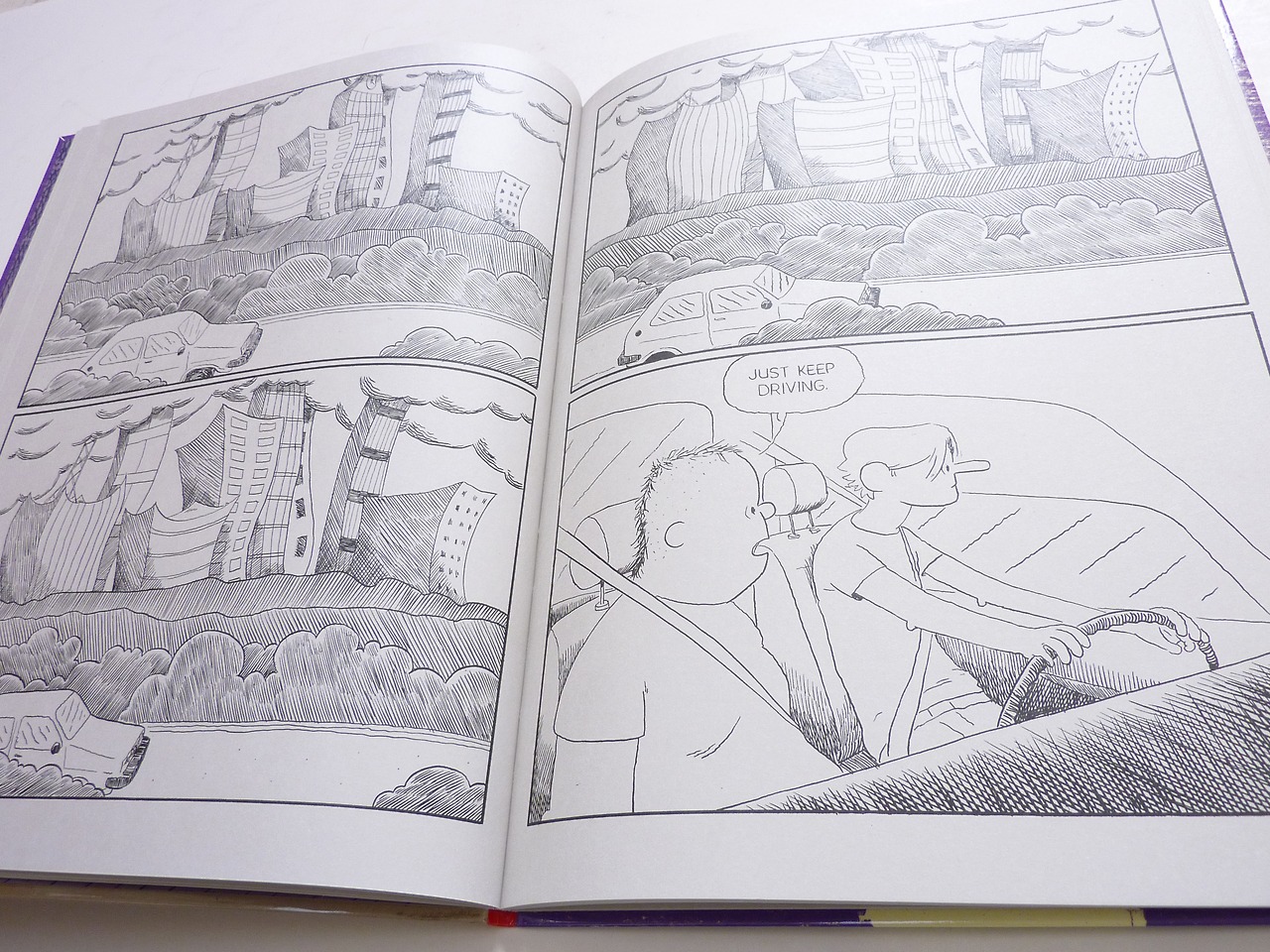
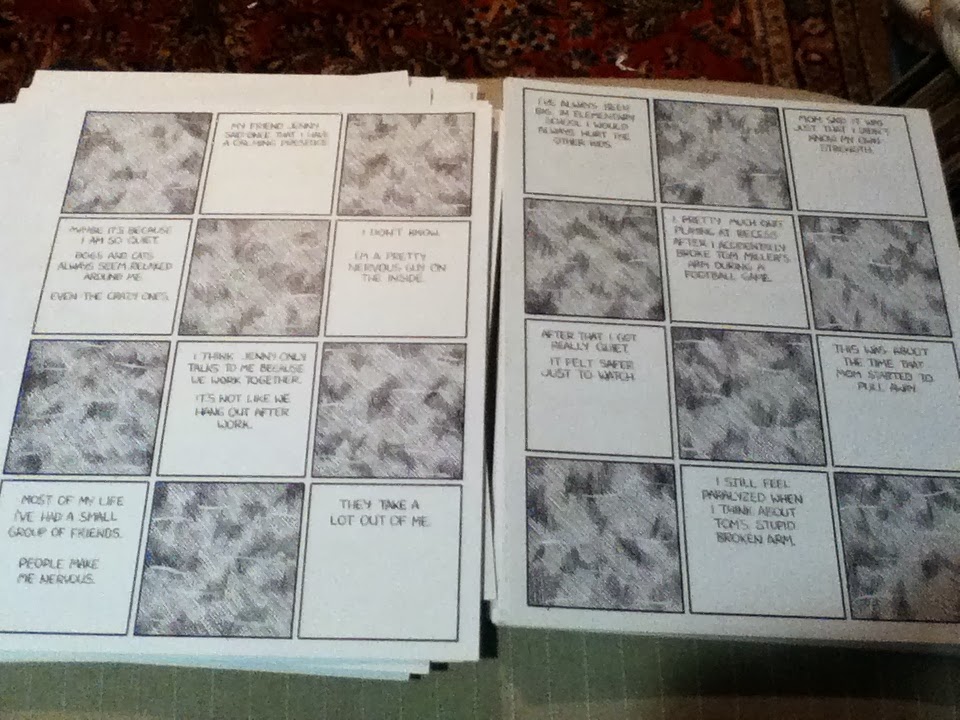
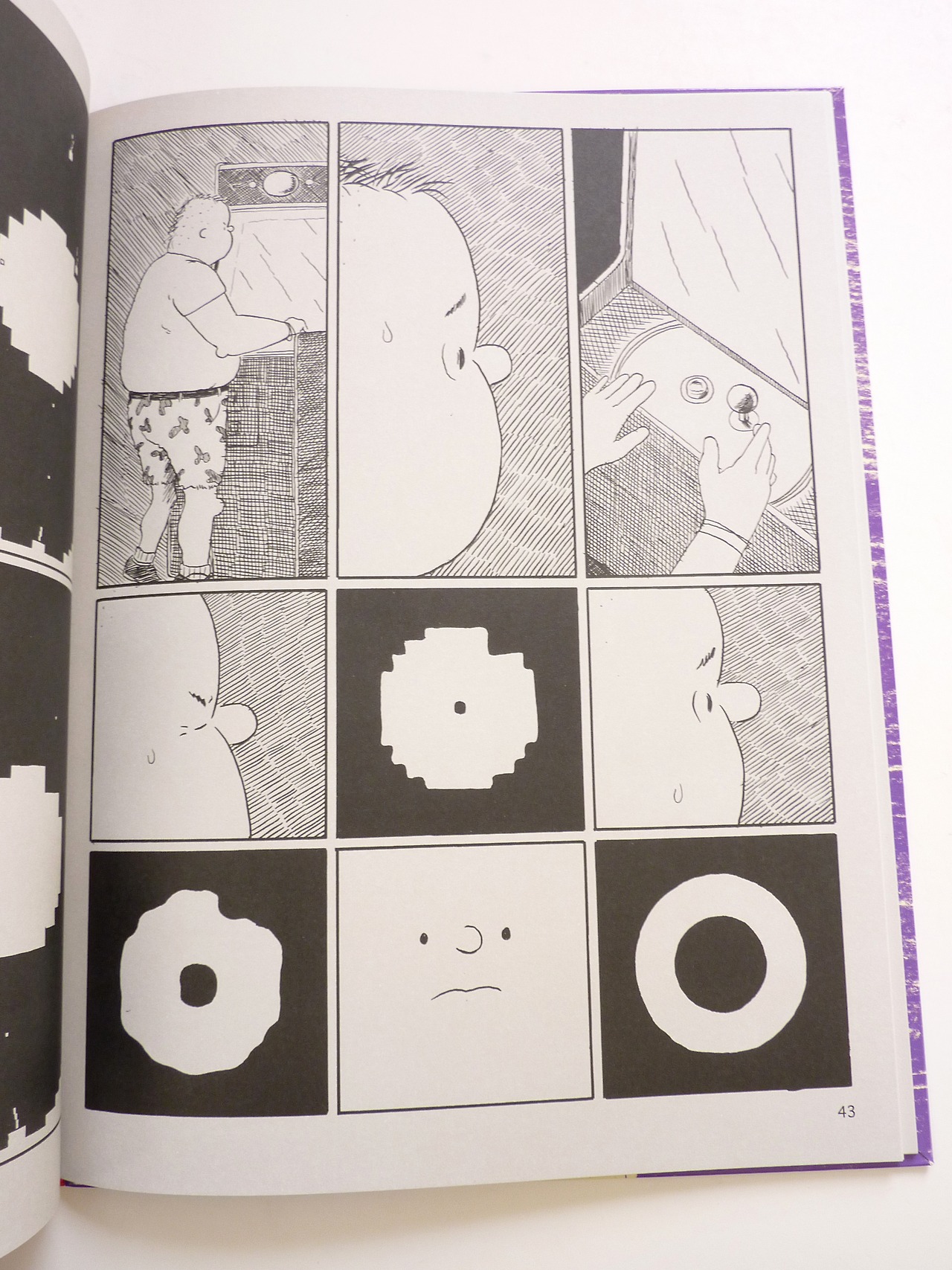
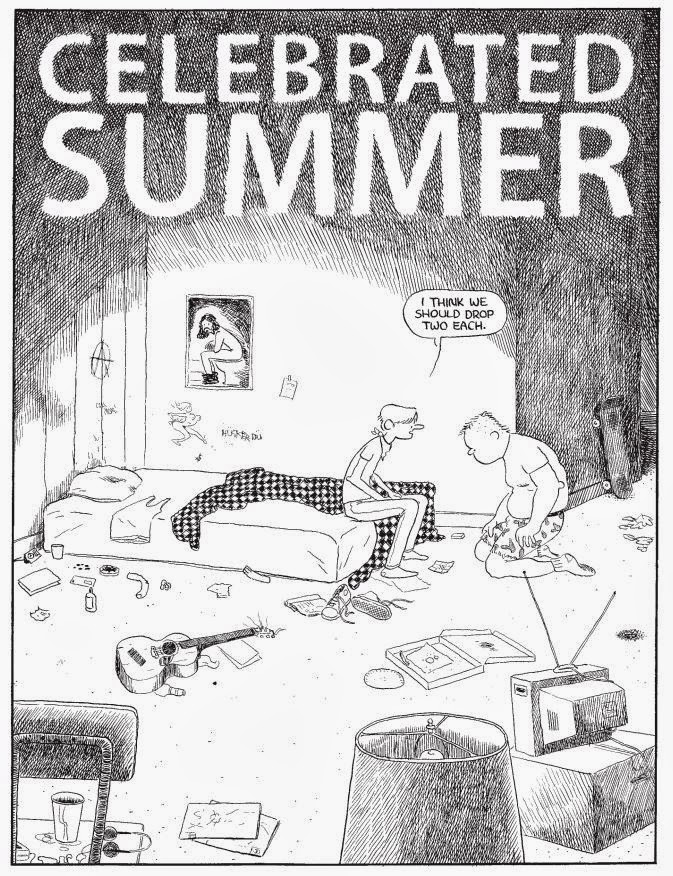
Charles Forsman’s quietly moving new book CELEBRATED SUMMER is essentially plotless. Two teenagers drop acid and drive around. That’s the whole story. There are no revelations along the way — their friendship doesn’t go through any changes, there’s no character arc. They just drive, from the arcade to the beach to the convenience store, and try to figure out whether they’re having any fun. Then they go home. It’s all rendered in Forsman’s punk-Hergé micron style, where the clear line of Kevin Huizenga meets the scratchy cross-hatching of Chester Brown.

This is Forsman’s second consecutive disaffected-teenage-roadtrip book, following the chilling, Badlands-inflected THE END OF THE FUCKING WORLD. But where TEOTFW was cold and harsh, preserving the mystery of its semi-sociopathic protagonists, CELEBRATED SUMMER is resignedly warm and humane. The former was an intense and frightening reading experience; the latter is a brief and mild one. But it’s also more thoughtful and assured, and in a very quiet way more formally and literarily ambitious than its predecessor.

The main character is Wolf (did he give himself that name?), a tubby, sensitive soul trying to pass as a rough outsider, with his fuzzy half-assed excuse for a mohawk and his Sluggo-style scalp stubble. His buddy Mike is a weaselly but good-natured little dork who sees himself as some kind of sleazed-up, street-smart operator.

Mike is clearly the leader of their little partnership, the one wielding the mantle of COOL KID in their little private world where no such thing exists. Mike is the one who drives the car, who announces destinations, who kicks off the book with a plan:

CB first page

Mike has an older girlfriend, and you can feel him weighing out the wages of dangerous adulthood when he says “I’m feeling less like her boyfriend and more like her dealer.” You get the sense he’s trying and failing to grow a mustache. Mike’s the one who keeps his cool when the cops cruise by, while Wolf curls up into the fetal position. In Mike’s mind this makes him an ice-cold outlaw, a position granted tacit endorsement by Wolf’s passivity.

Because Wolf is lost and scared, hoping to hook into some post-adolescent conduit to carry him away from his fat-kid-at-the-pool past and his post-high-school-nobody present. He’s just graduated, scaling the wall that hems in the world of children, and found nothing on the other side. When Mike asks what it’s like to be done, he says, “I kinda don’t feel anything… it just sort of ended, man.” That’s what the acid trip is about, really — he wants to crack through his empty, trackless reality to find someplace new to go, and someone new to be. But all the drugs do is make things wiggle and shift, and take away his ability to piss.

CB face mirror

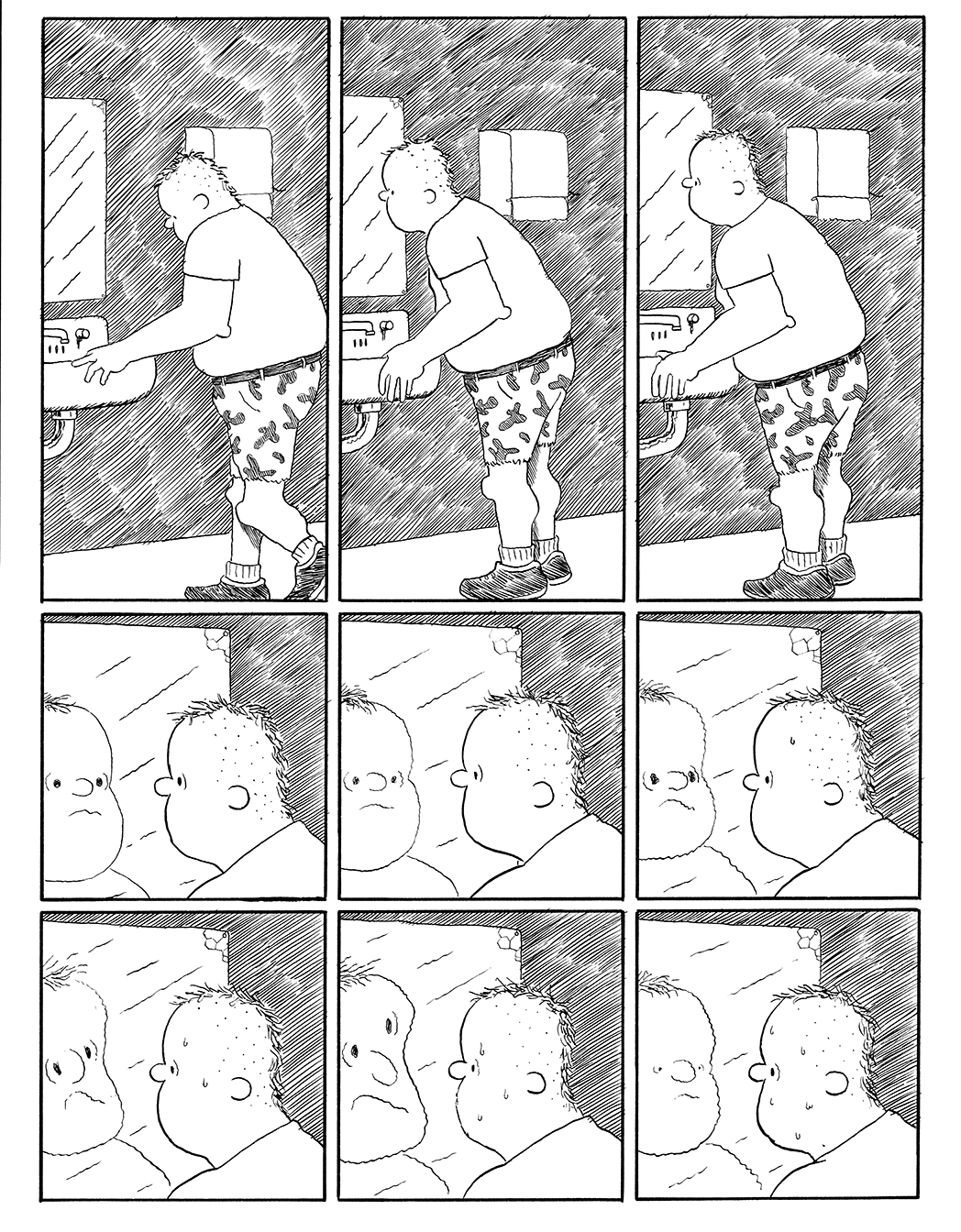
Forsman’s depiction of the trip violates every acid cliché and leaves you with an LSD experience that lays bare the rawness of the material world and gently warps your perceptions around its borders. Everything is funny and scary. Where most artists would go the day-glo-electric-kool-aid route and give us spirals and abstractions, a world melting into bubbling goop and neon colors, Forsman just subtly bends his monochrome reality, frays it at the edges, and yet when it’s played off his anxious minimalist style, the results are more vertiginous and immersive than the hyperactive overstimulatory experimentation of most acid-trip artwork. There’s no indulgence here.

The brief transcendent moments are fleetingly real, like when Mike becomes enraptured by a tiny white flower. Mostly there’s just restlessness, as these kids drive and wander aimlessly, two teenage satellites adrift in a black vacuum, just barely hopeful enough to continue moving through the stars.

CB buildings

The only deviations from Forsman’s fly-on-the-wall matter-of-factness come in brief but effective glimpses into Wolf’s head, when he speaks in monologue. His thoughts are honest and ineloquent, quietly searching and self-pitying.

One panel simply says “I’ve always been big. In elementary school I would always hurt the other kids.” As the story moves we get more of a sense of Wolf and his withdrawal, his absent waywardness a scrim behind which to hide his anxiety and anguish, even from himself.

“This was about the time mom started to pull away.” We don’t get any more info on Wolf’s parents that that, but it’s all we need – they’re somehow gone, and he’s left with his fretful grandmother, who he sweetly thinks to call even in the middle of an acid trip.

CB rain

The comic takes its title from a great Husker Du song that splits the difference between between sneering and nostalgia. “Just when I’m ready to sit inside, it’s summertime.” The big chunky power chords of that song build until they suddenly drop out, leaving a twelve-string guitar and a beautiful Bob Mould melody that couldn’t sound more out of place in a hardcore punk song. The glimpses into Wolf’s head serve, jarringly, like that unexpected bridge, offering you a radically different tone, something sad and kind bubbling just under a careless surface.

The book’s final moment is its most courageous. Wolf walks through the rain in his dirty sweatshirt the day after the trip, remembering his childhood. “I can never be there again,” he thinks. “I cannot be saved.” And then, as he steps through a puddle, we see him as a little boy, snug in his raincoat, with a caption that reads, “I’d give anything to not be scared.”

This is so direct and sincere that it dances dangerously close to maudlin sentimentality. It’s clearly a moment designed to pull your heart into your stomach. But its power is in its irony: Here is Wolf, perched on the verge of a voided adulthood, peering back with longing at a youth that was probably not much happier, just safer. The only difference was that there used to be someone to wrap him in a coat when it rained.

But this kid has his grandmother to yell at him for staying out all night while making him a BLT. And someday, after he’s found and lost his bearings a dozen times, he will look back wistfully on the simple melancholy of a summer when school was done and he was high and all he had to do was drift. The story ends on Wolf reaching back for a lost youth, with no sense of how much more he’s bound to lose.

circles– Josh O’Neill
 

good this week

the wake part one : this is a smart offering, collecting issues 1-5 of the much-buzzed-about sci-fi horror story from popular creators scott snyder and sean murphy. a creepy, claustrophobic yarn that will read better in chunks, this one is highly recommended.

Image

pretty deadly #3 : the strongest issue yet of this myth- & blood-drenched spaghetti western. one of the best single issues of the year.

Image

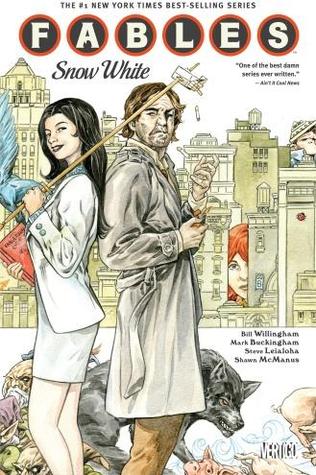
fables volume 19 : the newest collection of the beloved series.

Image

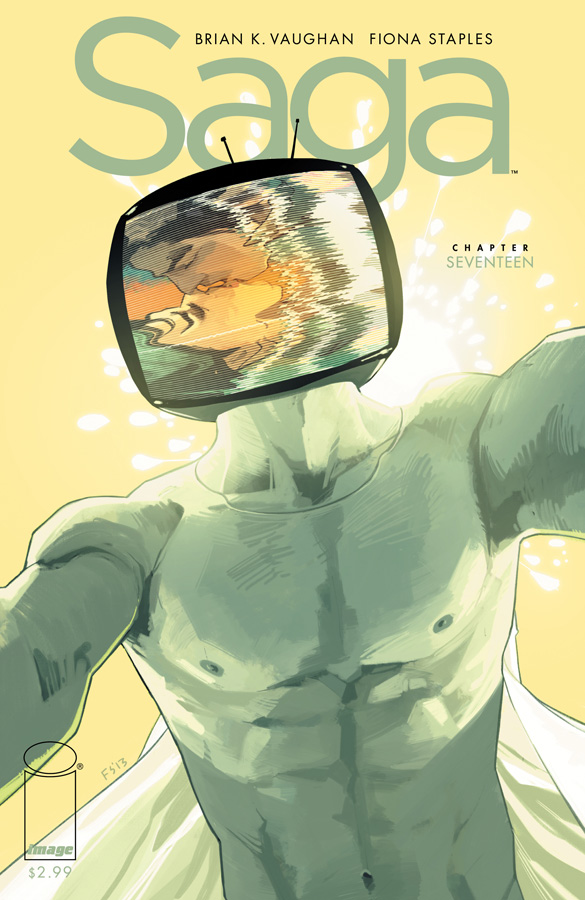
saga #17 : the most consistently entertaining book of the last two years, with no sign of slowing down.

Image

east of west #8 : this book gets my year-end vote for ‘BEST OF’.

Image

figma metroid action figure set : yep.

Image

Image

–chris stevens

Tuesday Tease

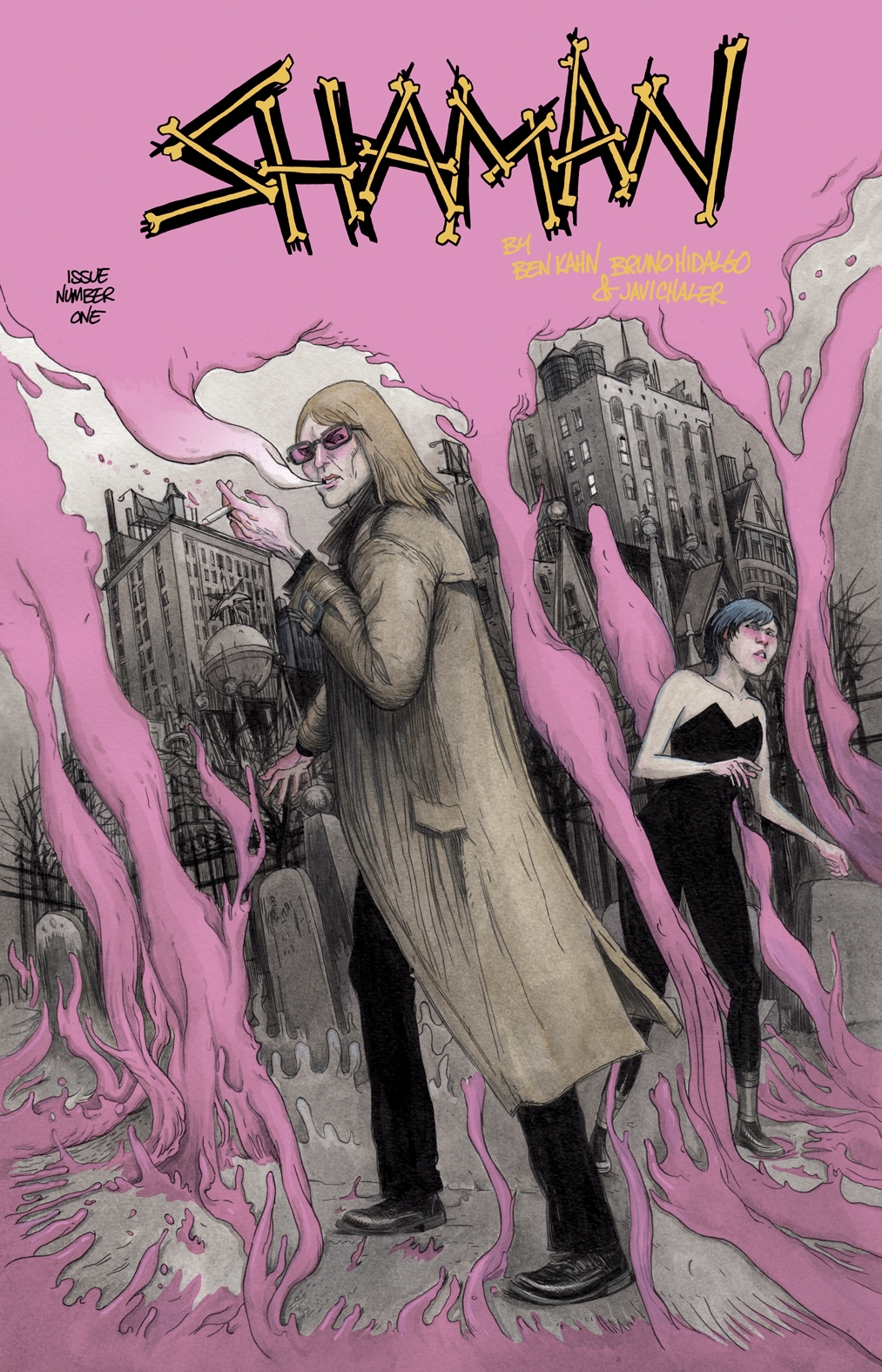
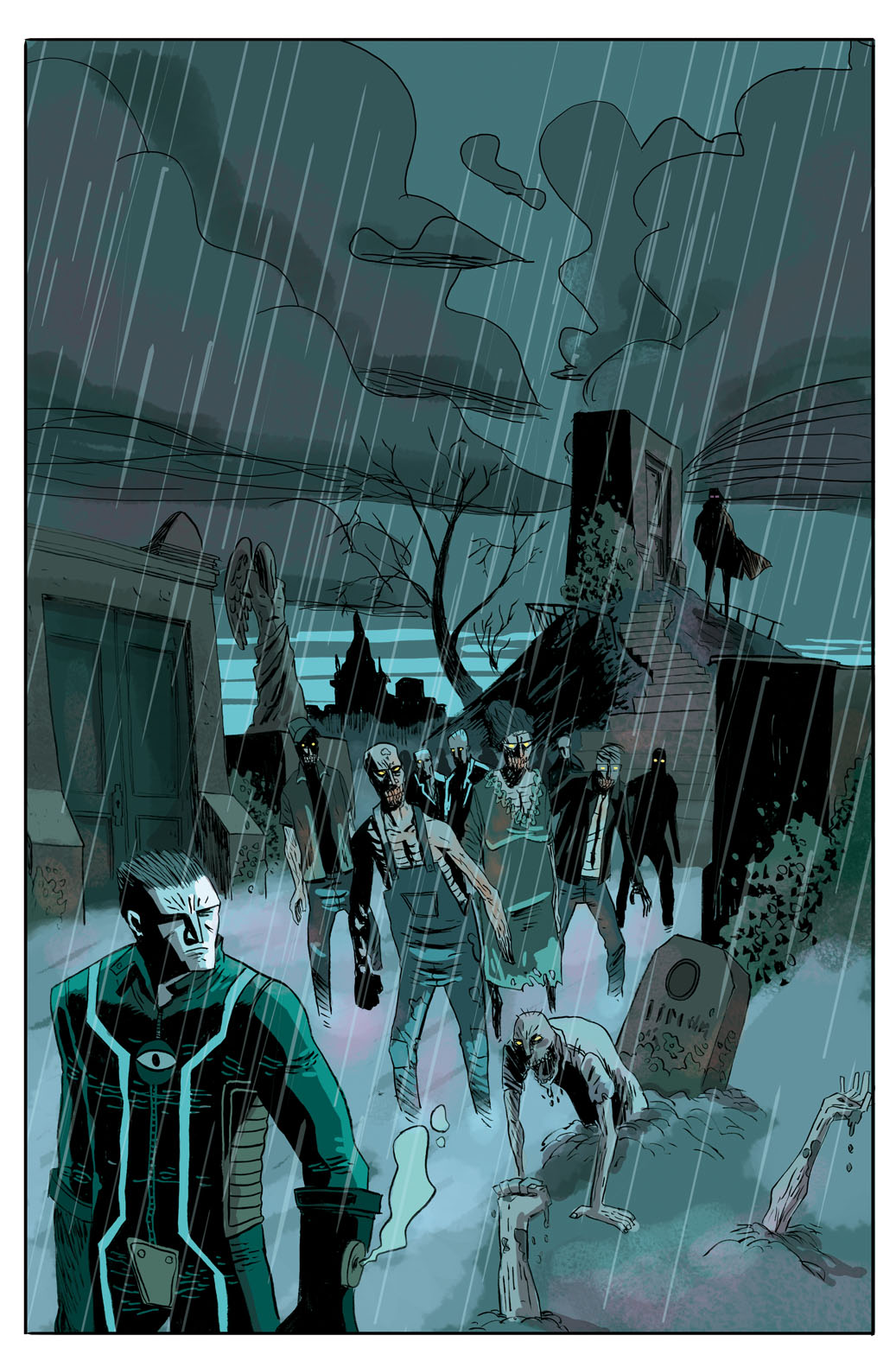
this week we take a look at a series we have been working on called SHAMAN. the way this project came about is an interesting story. when we closed down the original locust moon there was about a year in-between opening up the current shop. during that year we were still obligated to receive books from diamond, and each week i’d meet the ups guy and haul the boxes of books up to my tiny apartment. this was a pretty shitty situation that was made a lot more tolerable by the fact about a dozen of our customers were loyal enough that they continued getting their books from us, meeting me in my apartment or outside my building. one of those customers was ben kahn, who was getting ready to graduate from upenn. ben had a real passion for the medium and a strong desire to create his own comics. once i realized that he was serious about it, i set off to help him make it happen. written and created by ben, illustrated by bruno hidalgo, and lettered by jason arthur, you will be seeing a lot more of SHAMAN in 2014. for now, here’s a look at the cover by farel dalrymple to the first issue and a page from bruno. SHAMAN logo designed by rob woods.shamanfarel_150dpiSHAMAN_ISSUE2_PAGE24
–chris stevens

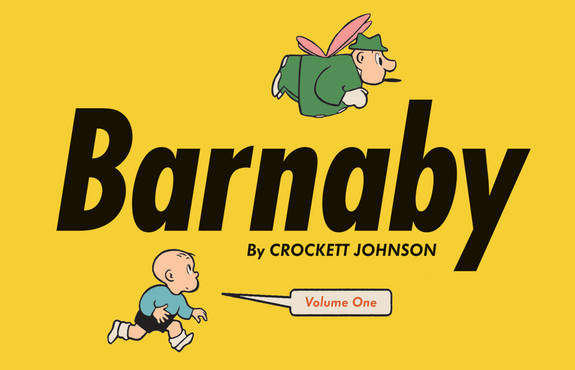
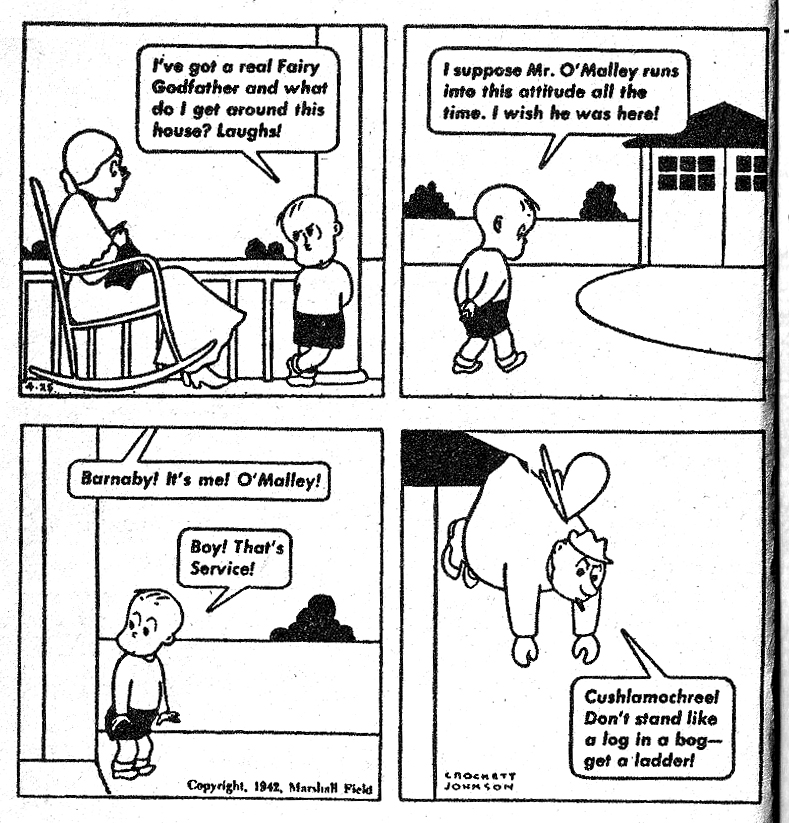
BARNABY, by Crockett Johnson

barnaby cover

BARNABY, by Crockett Johnson, is less a newspaper strip than it is an object of love. Only mildly successful during its 1942-1952 run (a warm-up for the career-making, genre-defining classic HAROLD AND THE PURPLE CRAYON, which features an identical protagonist), it has attracted not a large fan base but a wildly, irrationally enthusiastic cult of supporters and proselytizers, including Dorothy Parker, Art Spiegelman, Duke Ellington, Chris Ware and Franklin Delano Roosevelt. (Now that’s a dinner party.)

Fantagraphics’ faithful and reverent new edition, with its beautiful banana-yellow, era-appropriate book design by Dan Clowes and wonderfully informative and enthusiastic essays, brings this nearly-forgotten material roaring back to life. Jeet Heer writes, “It’s hard to talk about BARNABY without raving.” Parker writes, “I cannot write a review of Barnaby… it is always a valentine for Mr. Johnson.” Having newly become aware of this comic, I am a late convert to their brand of tongue-twisted devotion to this wonderful proto-Calvin & Hobbes creation — this off-beat, sweet-hearted suburban saga located at the junction where modernism meets magic.

barnaby1

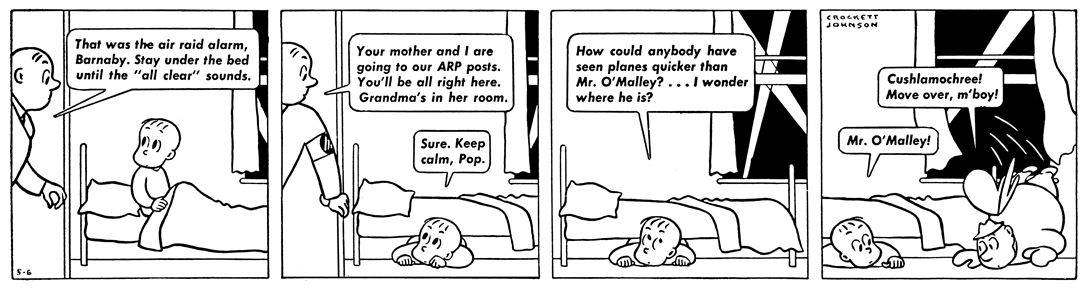
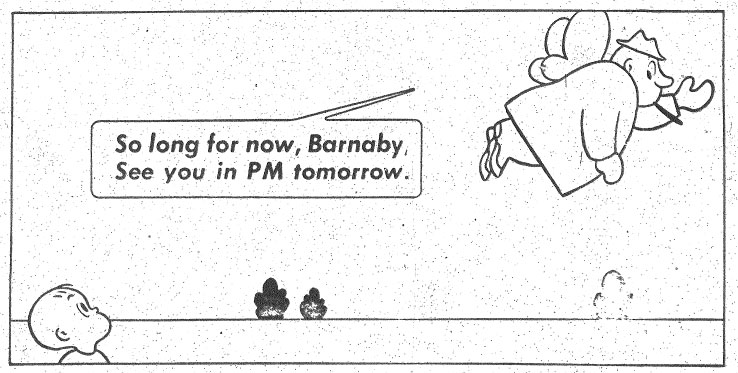
The subject of BARNABY is the relationship between the titular adolescent boy and Jackeen J. O’Malley, his glad-handing, possibly-imaginary roustabout of a fairy godfather. O’Malley is a character for the ages — less guardian angel than drunken uncle, full of patter and tall tales, possessed by insatiable appetites for food and drink and self-regard. He bluffs his way into Barnaby’s high esteem, and shanghais him into ill-considered schemes and misadventures. It all plays out against the backdrop of the second World War – a perfectly appointed middle-class idyll disrupted by air raid sirens, rationing and the draft. BARNABY is entirely a product of its era, with many references to the politics of the day, but it also has a folkloric quality. It seems to float, as the best newspapers strips do, in some eternally mythic American moment.

BARNABY air raid

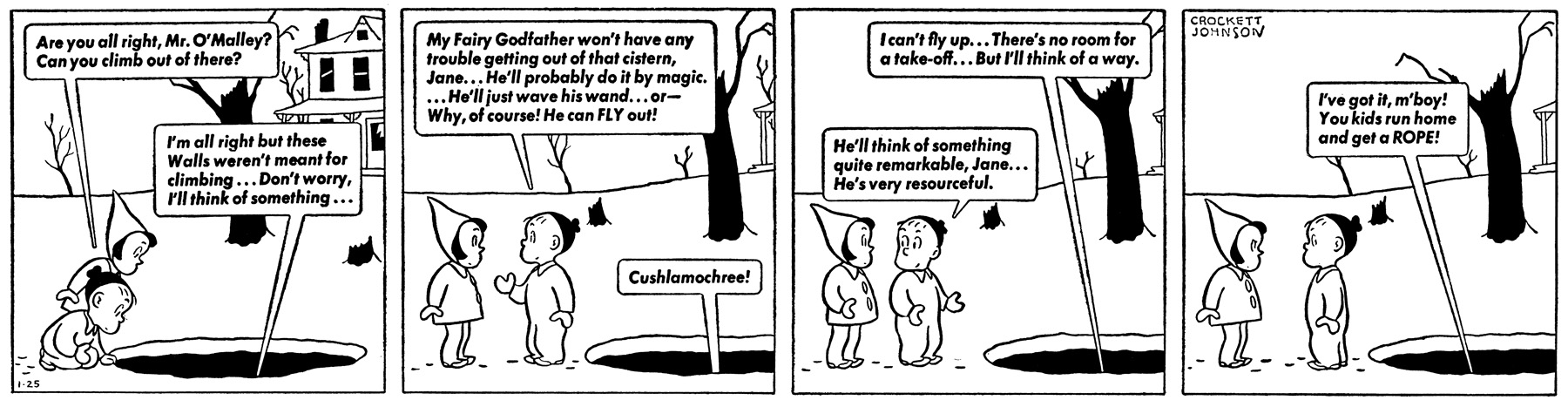
The central joke is that Barnaby, unlike Calvin, is no hyper-active kid with an outsized imagination. He’s calm and collected, a reasonable, well-adjusted little boy. His personality is perfectly reflected in Johnson’s almost translucently clear-line cartooning, in which everything is boiled down to its barest essence — life as one big declarative sentence. Not a pen-stroke is given to nuance or shading. Barnaby’s belief in O’Malley is equally uncomplicated and complete, emblematic of his character as a whole: his fairy godfather is magical and heroic by definition, and no failure to display his powers or act heroically (or even decently) will convince him otherwise. Everything about Barnaby is matter-of-fact; everything about O’Malley, from his braggadocious claims to his very existence, is a matter of fiction. The sweetness of their relationship is that O’Malley gets to be grand and mystical in the eyes of the kid, and the kid gets proof positive that the world is an enchanted place. O’Malley is just a mostly-incompetent con man with wings, but he gives the gift of magic to this quiet, cool-tempered child.

barnaby magic

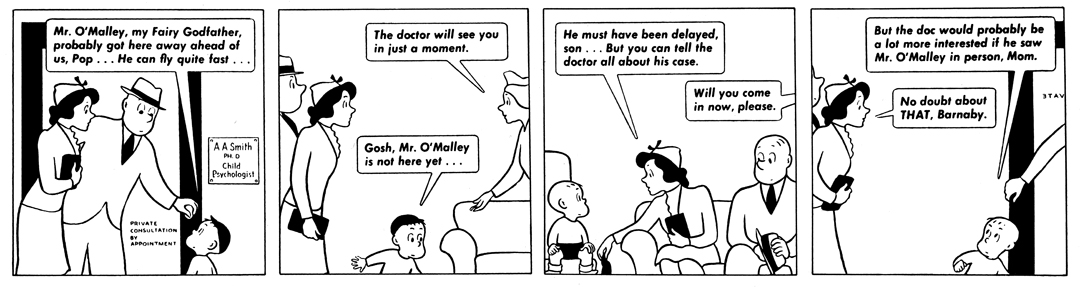
Everything in Barnaby’s world is trying to shoot down the fantasy. Parents, teachers, and child psychologists all conspire to snap him out of the delusion. But his faith in the supremacy of his fairy-godfather can’t be shaken. Despite the fact that O’Malley’s “magic wand” seems to be a cheap cigar, and excepting his power of flight O’Malley never exhibits a single supernatural ability, Barnaby is utterly convinced of his pal’s near-omnipotence.

barnaby doctor

There’s a curious blurring of the strip’s reality halfway through the book, when it turns out first O’Malley can be seen by other children, and the later by mobsters, drunks, and other fringe elements. So the strip, which initially seems to be about a boy and his imaginary friend, gets an authorial endorsement of its fantasy: O’Malley is real — he’s just invisible to members of the establishment. The rock-solid button-down social machinery of work, school, home, whether in peacetime or war, cannot be penetrated by the very real outre magic of Barnaby’s backwoods.

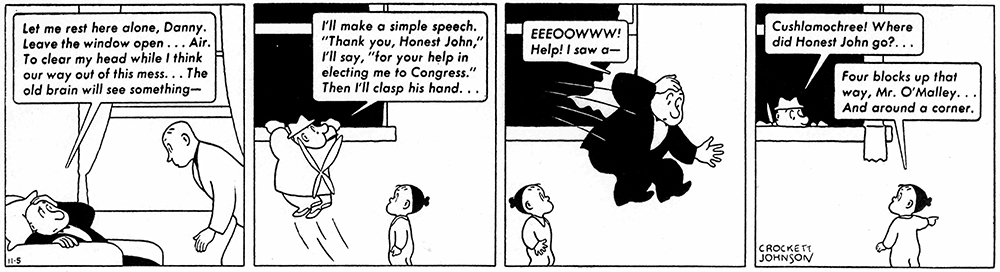
Until Mr. O’Malley is elected to Congress.

barnaby congress

This is the kind of great joke that Johnson specializes in: oddness and disruption so deadpan it seems obvious. Barnaby’s dog Gorgon, it’s suddenly revealed, can talk — but he turns out to be such a rambling bore that everyone just wishes he would shut up. When Barnaby and O’Malley go to visit a giant, he turns out to be three feet tall and “sensitive about his size.” There are very few belly laughs to be had here, more quiet chuckles, and many of the strips seem to forget to supply any punchline at all. But you don’t care — you’re not here for payoffs, you’re here to be immersed in this clean, cracked world, the wry amusements and the utterly recognizable characters who stick with you. The solid earth of perfectly crisp drawing and flawlessly defined personalities allows Johnson to play fast and loose with his invented reality.

The brilliance of all this is that, through some mysterious alchemy of cartooning and character, it manages to provoke an immense reaction of love in the reader, without ever resorting to any kind of sentimentality or manipulation. There are no occasional moments of heart-tugging sweetness, like there were in Calvin & Hobbes, no Schulzian pathos. Just a dry, almost clinical depiction of the adventures of this boy and his favorite figment. The depiction is so coldly clean, so unwilling to invest itself in its characters’ points of view, that for all of its charm and ease it has an almost autistic, Kubrickian gaze.

And yet, when Dorothy Parker describes these characters as “important additions to my heart,” I am right there with her. There’s something unguarded and hopeful in the total lucidity of the storytelling and the sharp-relief definition of the characters, something unjudgemental and welcoming and unafraid, that invites you in. And if you answer that invitation, before you know it, Mr. O’Malley will storm into your house, ravage your ice-box and light up a cigar.

omalley

Maybe that’s unsurprising — O’Malley is a pure force of blustering charm & friendly bullying presumption. It’s his nature to tromp in where he isn’t invited. But you will also find that, very quietly, this little watchful boy with his wide American eyes and gullibly observant optimism has pulled up a chair. He sits there with his polite smile and uncanny enthusiasm, and compels you to invest some small, unconflicted piece of yourself in the most mundane & preposterous magic.

And like Barnaby, we will take our magic where we can get it.

barnaby end– Josh O’Neill